

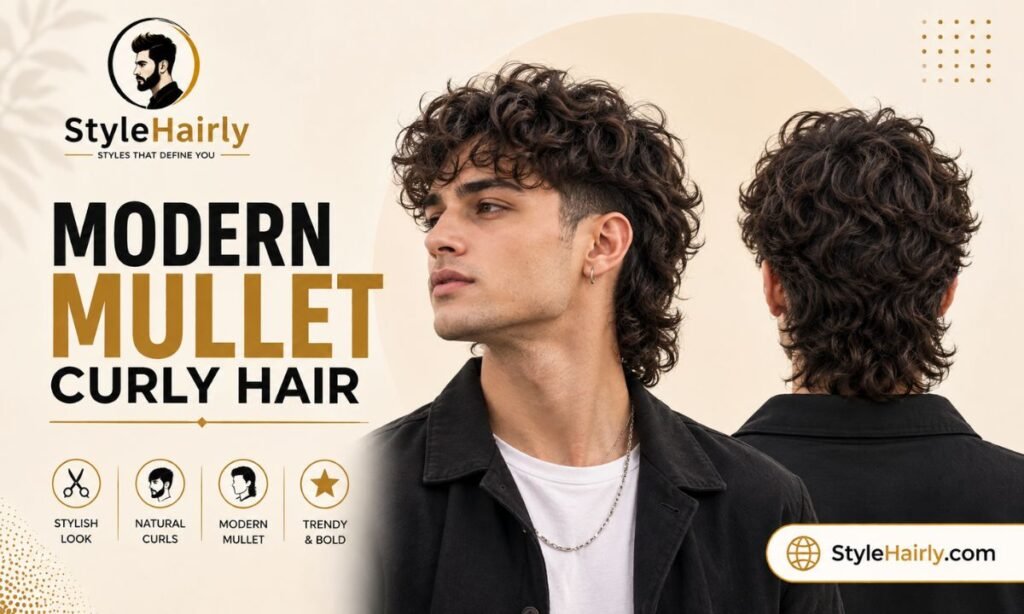
Curly hair adds natural volume and texture to a mullet, but it also changes how the cut needs to be built. Curls behave differently at the crown, sides, and nape than straight or wavy hair, so a mullet that looks great on straight hair can look shapeless or bulky on curls if the layering and fade are not adjusted for curl pattern.
A modern mullet on curly hair works best when the barber shortens and fades the sides while leaving enough length and layering on top and in the back for the curl pattern to show through. The result is a style with more shape at the crown, a defined but not harsh line at the sides, and natural movement in the back instead of a flat, one-length mullet.
This guide covers the fade options that pair best with curly hair, the most requested modern mullet variations for curly texture, how to choose between them based on hair type and face shape, what to tell your hairstylist, and how to style and maintain the cut at home.
Modern Mullet Curly Hair at a Glance
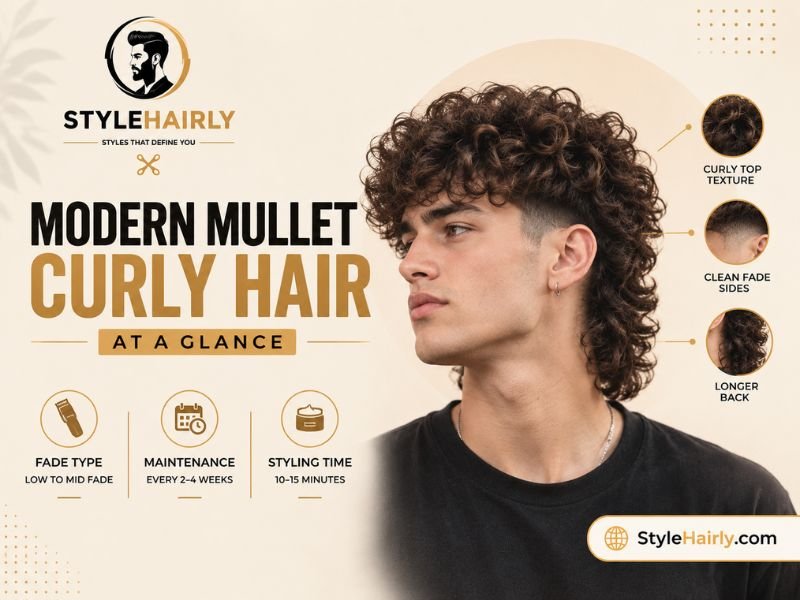
- Best for: Naturally curly or coily hair with medium to high density
- Hair length needed: At least 3 to 4 inches on top and in the back before cutting
- Common fades: Low fade, taper fade, burst fade, skin fade, mid fade
- Maintenance: Fade touch-up every 2 to 3 weeks, trim on top every 6 to 10 weeks
- Styling time: 5 to 15 minutes depending on curl definition desired
- Main feature: Short, faded sides with longer, layered curls on top and at the nape
What Is a Modern Mullet Curly Hairstyle?
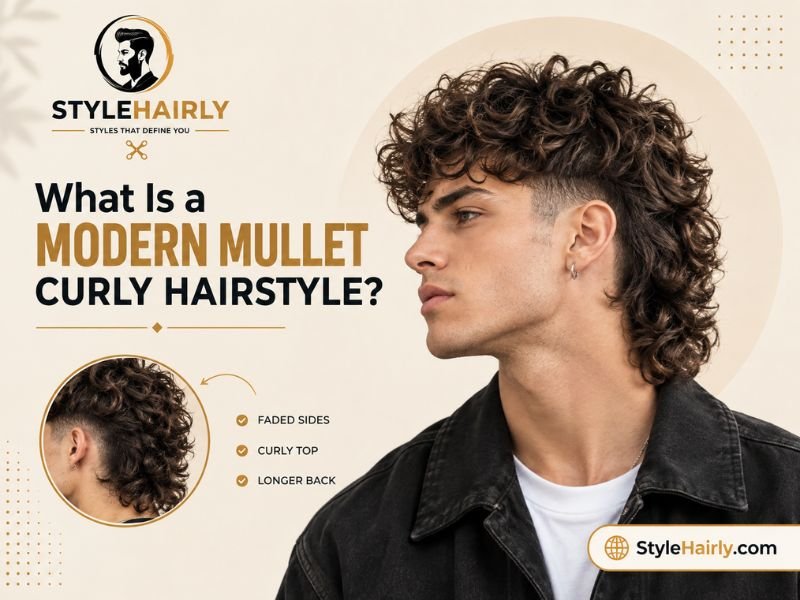
A modern mullet curly hairstyle takes the classic short-sides, long-back mullet shape and rebuilds it around curl pattern instead of straight length. Instead of one flat length at the back, the cut uses layering so curls can spring, coil, and separate naturally, while the sides are faded rather than simply left short and blunt.
Hair Type and Texture Suitability
This style works across curl types, but the approach changes with texture. Loose curls (type 2) tend to sit closer to the head and may need a diffuser or curl cream to hold shape through the day. Springy, well-defined curls (type 3) usually show off the mullet’s layering the most clearly with the least effort. Tighter coils (type 4) often benefit from slightly more length on top so the layers have room to shrink into shape once dry, since coily hair can shrink noticeably from wet to dry.
Fine curly hair usually looks better with a shorter back section and a lower fade to avoid looking thin or stringy, while thick curly hair can carry more length and a higher-contrast fade without looking overwhelming.
Face Shape Suitability
Round and square faces often benefit from added height at the crown and a fade that keeps the sides from adding width. Oval and heart-shaped faces have more flexibility and can usually wear most curly mullet variations without adjustment. Longer faces may want to avoid excessive height on top and instead focus on side volume and a soft fringe to balance proportions.
Styling Overview
Most curly modern mullets are styled by applying a leave-in conditioner and curl cream or gel to damp hair, then either air-drying or diffusing to encourage curl clumping. A full styling routine is covered later in this guide.
Maintenance Overview
The fade needs refreshing every 2 to 3 weeks to stay sharp, since curly hair at the sides grows out and softens the fade line faster than it may appear. The longer top and back sections usually only need trimming every 6 to 10 weeks, since some length loss is expected as layers are shaped.
Pros and Cons
Pros
- Uses natural curl pattern instead of fighting it
- Sides stay low-maintenance between fade appointments
- Layering reduces bulk on thick or dense curls
- Works with both casual and slightly polished styling
Cons
- Requires more frequent fade upkeep than a non-faded mullet
- Curl shrinkage can make length harder to predict when growing it out
- Needs the right products to avoid frizz overtaking the shape
- Not every barber has experience cutting curly hair specifically, so a consultation matters
Modern Mullet vs Classic Mullet on Curly Hair
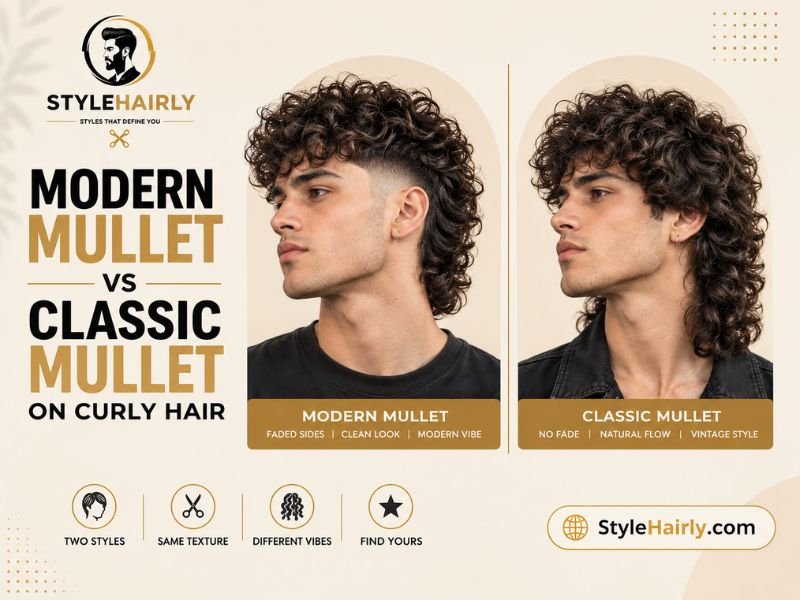
| Feature | Modern Mullet (Curly) | Classic Mullet (Curly) |
| Sides | Faded (low, mid, taper, burst, or skin) | Usually short, not faded |
| Layering | Heavily layered top and back | Often one length in the back |
| Shape | Rounded, textured silhouette | Flatter, more uniform silhouette |
| Styling effort | Product-dependent, curl-focused | Minimal styling |
| Best for | Curl definition and shape control | Low-maintenance, retro look |
Best Fade Styles for Modern Mullet Curly Hair
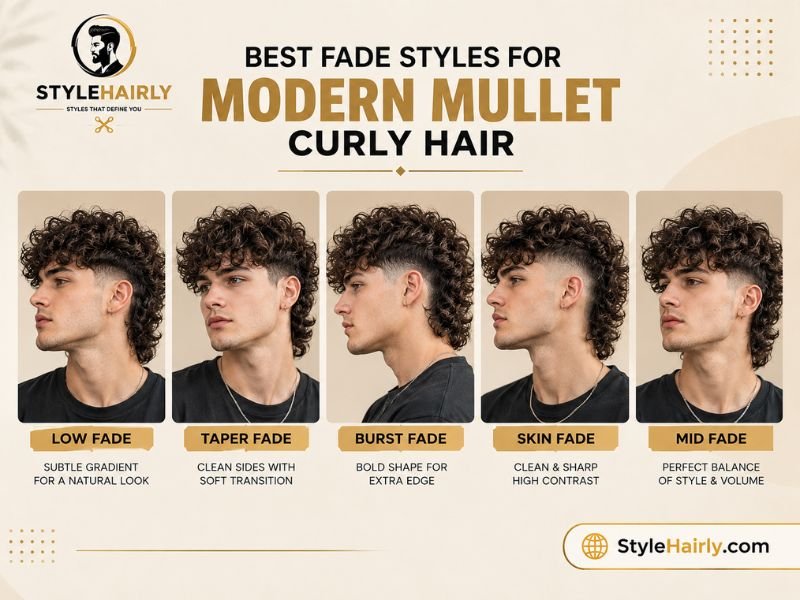
The fade is what separates a modern mullet from an old-school one, and the right fade depends on hair density, how much contrast you want, and how often you’re willing to get it maintained. The five options below are the most common pairings with curly hair.
Low Fade Curly Modern Mullet
A low fade keeps the fade line close to the ear and hairline, leaving more length on the sides than a mid or skin fade. It is the most subtle option and works well for men who want a cleaner look for work or school without losing much side volume.
Best for: Fine or thinning curly hair, conservative or professional settings Styling tip: Keep sideburns intact to avoid harsh contrast with the low fade line Maintenance: Touch up every 3 weeks; the low placement grows out more slowly than higher fades
Taper Fade Curly Modern Mullet
A taper fade gradually shortens the hair around the perimeter without creating a hard fade line, so it blends more softly into the curls on top. It is one of the easiest fades to grow out evenly.
Best for: Men who want a fade that still looks intentional weeks after a cut Styling tip: Ask for the taper to blend into the nape as well, not just the sides, for a seamless back transition Maintenance: Can often stretch to 3 to 4 weeks before it looks uneven
Burst Fade Curly Modern Mullet
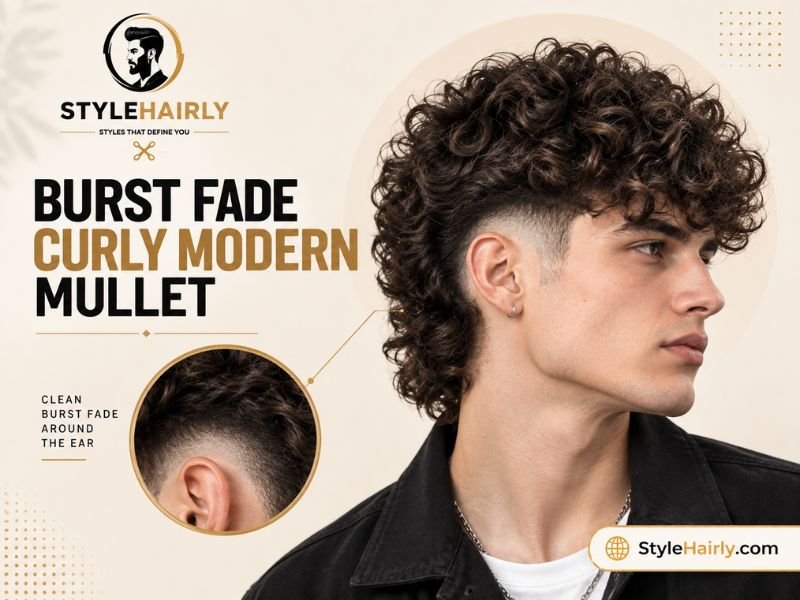
A burst fade curves around the ear rather than running in a straight line down the sideburn, which pairs naturally with the rounded shape curls create on top. It is currently one of the more popular fade choices for curly mullets.
Best for: Medium to thick curls that already have a rounded silhouette Styling tip: Let the crown curls stay slightly longer than the back to keep the burst shape balanced Maintenance: Needs refreshing every 2 to 3 weeks since the curved line shows growth quickly
Skin Fade Curly Modern Mullet
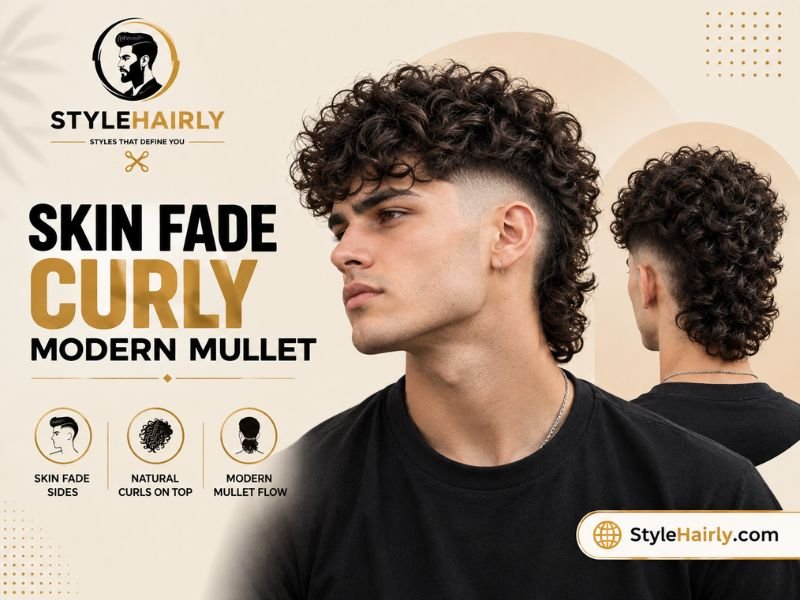
A skin fade takes the sides all the way down to the skin at the bottom before blending upward. It creates the highest contrast against the curls on top, which reads as a bolder, more modern look.
Best for: Thick or dense curls that can visually balance the sharp contrast Styling tip: Use a curl-defining cream on top so the density up there matches the boldness of the fade Maintenance: The most upkeep-heavy option; usually needs a touch-up every 2 weeks
Mid Fade Curly Modern Mullet
A mid fade starts partway up the sides, offering a middle ground between the subtlety of a low fade and the contrast of a skin fade. It is often the most versatile choice across face shapes.
Best for: Most face shapes and curl densities; a safe default when unsure which fade to choose Styling tip: Works well with almost any top length, from short and textured to longer and shaggy Maintenance: Every 2 to 3 weeks to keep the blend clean
Best Modern Mullet Curly Hairstyles to Try
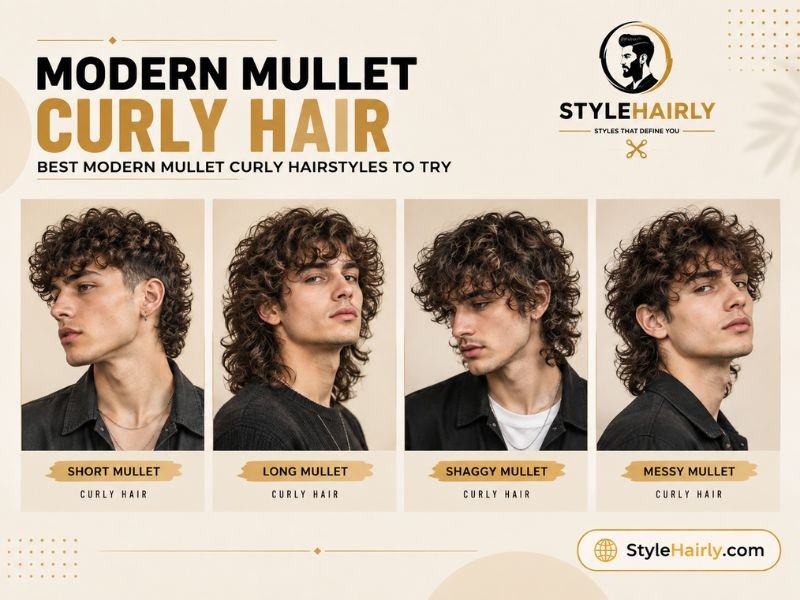
Once a fade is chosen, the top and back layering is what defines the specific mullet variation. Here are the most requested styles for curly hair right now.
Short Curly Modern Mullet
This version keeps both the top and the back shorter than a typical mullet, which makes the curl pattern more compact and easier to manage day to day.
Best for: First-time mullet wearers or men who want lower daily styling effort Styling tip: A light curl cream is usually enough; heavy product can weigh down shorter curls Maintenance: Trim every 6 to 8 weeks to keep the shape from growing out shapeless
Long Curly Modern Mullet
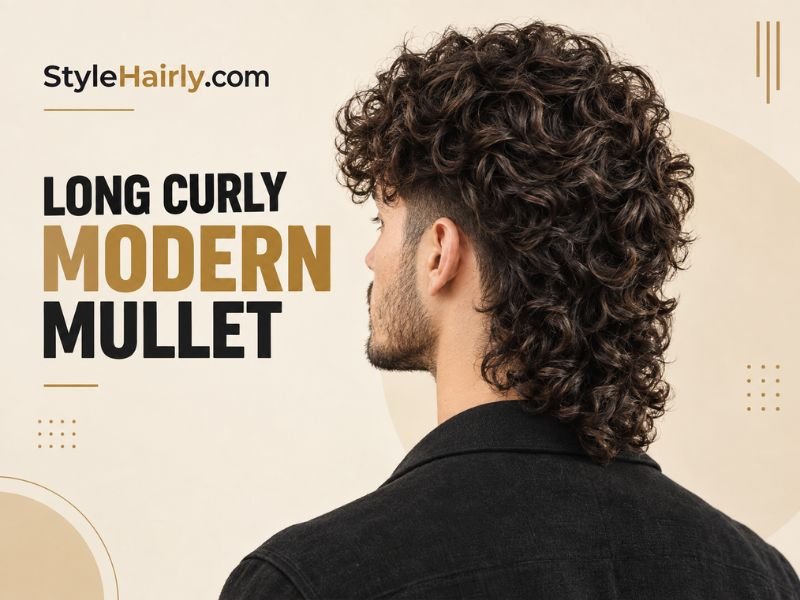
The long version maximizes the contrast the mullet is known for, with noticeably more length left in the back for the curls to spring and coil.
Best for: Thick, well-defined curls that hold shape at longer lengths Styling tip: Diffuse the back section separately to encourage clumping instead of letting it dry flat under its own weight Maintenance: Trims can stretch to 10 weeks since more length is intentional
Shaggy Curly Modern Mullet
A shaggy curly mullet uses choppy, piece-y ends throughout instead of blunt layer lines, giving it a looser, retro-influenced silhouette.
Best for: Men who want a lived-in, slightly undone look rather than a sharply defined one Styling tip: Scrunch a texturizing spray into damp curls instead of combing through, which preserves the choppy effect Maintenance: Regular trims every 6 to 8 weeks keep the ends from looking overgrown rather than intentionally shaggy
Messy Curly Modern Mullet
This variation leans into an undone, no-part finish, where the curls are left to fall naturally without much direction.
Best for: Low daily styling time and hair types that hold curl shape without much product Styling tip: Finger-style instead of using a comb or brush, which keeps individual curl clumps intact Maintenance: Fade upkeep matters more here since the top requires almost no cutting-related maintenance between trims
Fluffy Curly Modern Mullet
The fluffy version maximizes volume, especially at the crown, for a fuller, rounder silhouette on top that contrasts with the fade.
Best for: Fine to medium curls that need extra lift to avoid looking flat Styling tip: Diffuse on a low, warm setting while scrunching upward toward the scalp to build volume at the root Maintenance: Regular fade touch-ups keep the sides from competing with the volume on top
Layered Curly Modern Mullet
Multiple layer lengths are cut through the crown and back, which reduces bulk and adds movement, especially useful on thick or dense curly hair.
Best for: Thick curly hair that tends to look heavy or triangular without layering Styling tip: Apply product from mid-length to ends only, since layering already reduces weight near the roots Maintenance: Layers need reshaping every 8 weeks or the different lengths can start to blend together
Textured Curly Modern Mullet
This style focuses on defining individual curl clumps and ringlets rather than an overall fluffy or messy shape, creating clear separation between curls.
Best for: Well-defined curl patterns (type 3 curls especially) that hold clump shape well Styling tip: Apply a curl cream or gel to soaking wet hair and avoid touching it again until fully dry to prevent frizz Maintenance: Trims every 6 to 8 weeks to keep the defined clumps from growing uneven
Curly Modern Mullet With Fringe
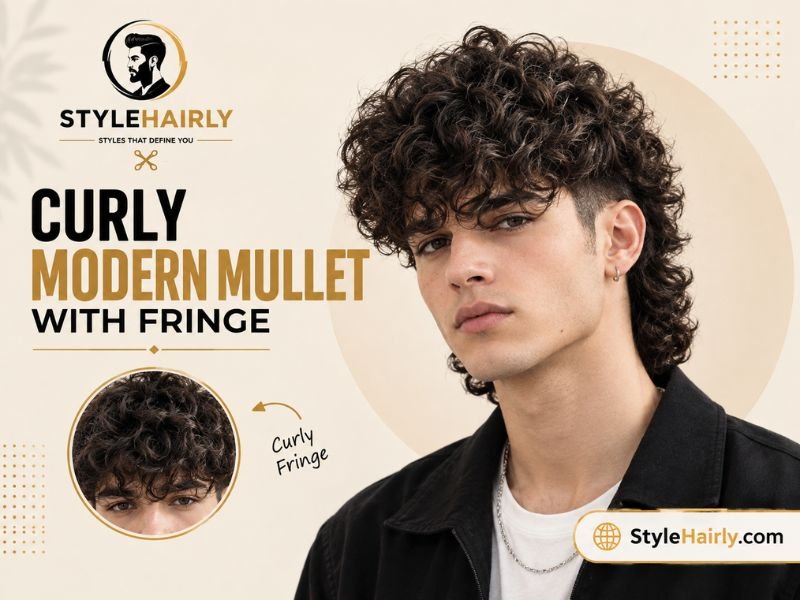
A curtain-like fringe or curl piece is left over the forehead, softening the face and adding a focal point at the front of the style.
Best for: Round or square face shapes that benefit from softened forehead framing Styling tip: Ask the barber to leave the front section slightly longer than the rest of the top specifically for this purpose Maintenance: The fringe usually needs trimming more often than the rest of the top, roughly every 4 to 6 weeks, to stay out of the eyes
Curly Wolf Mullet
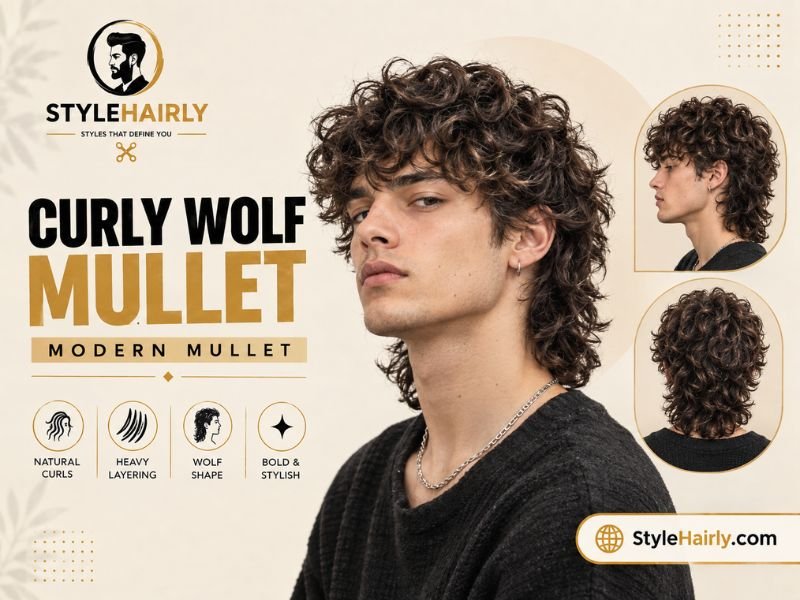
This hybrid blends the heavy, shaggy layering of a wolf cut into the classic mullet shape, resulting in a more textured, rock-inspired look with layers cut throughout rather than concentrated at the back.
Best for: Men wanting an edgier, more dramatic silhouette than a standard mullet Styling tip: Use a matte paste on the ends only to keep the piece-y texture without adding shine that softens the rougher look Maintenance: Heavier layering means more frequent trims, around every 6 weeks, to keep the shape from collapsing
Curly Modern Mullet With Highlights
Adding highlights or a subtle color contrast to a curly modern mullet emphasizes the layering and curl definition by making individual sections and curl clumps more visible.
Best for: Men who already have healthy, well-maintained curls, since color adds some dryness risk Styling tip: Use a color-safe curl cream or leave-in to protect both the curl pattern and the color from fading Maintenance: Color needs its own touch-up schedule (often every 6 to 10 weeks) separate from the haircut itself
Curly Modern Mullet With Beard
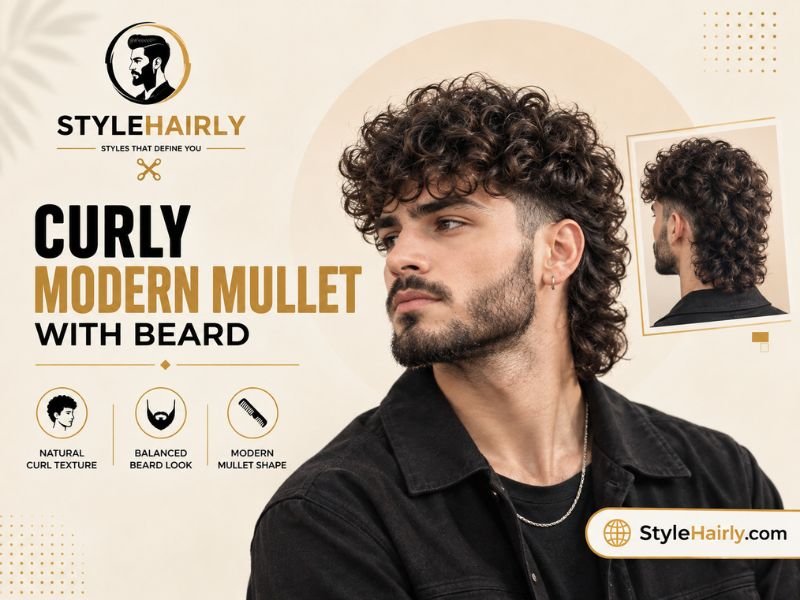
Pairing a beard with a curly modern mullet is more about balance than a separate haircut. A fuller beard generally pairs better with a mullet that has more volume on top, while a shorter, groomed beard suits shorter or more tapered mullet versions.
Best for: Men who already grow facial hair and want the beard and haircut to feel proportional Styling tip: Keep beard length roughly in proportion to top hair length so neither one visually overwhelms the other Maintenance: Beard trims are typically needed more often (every 1 to 2 weeks) than the haircut itself
Natural vs Salon-Polished Curly Modern Mullet
The same cut can look noticeably different depending on the finish. A natural finish means letting curls air-dry with minimal product for a relaxed, everyday look. A salon-polished finish usually involves diffusing, curl creams or gels, and sometimes a light hold spray for more defined, camera-ready curls.
Best for: Natural finish suits everyday wear; polished finish suits events, photos, or professional settings Styling tip: Keep both a lightweight everyday product and a stronger-hold option on hand so you can switch finishes without changing the cut Maintenance: Neither finish changes the fade or trim schedule; the difference is purely in daily styling effort
Curly Hair vs Straight or Wavy Hair: How the Modern Mullet Changes
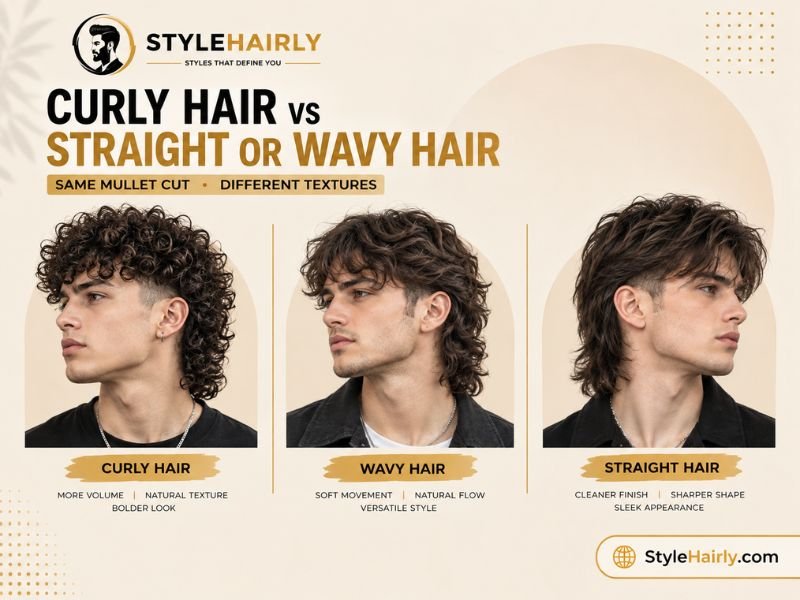
The same modern mullet shape can look quite different depending on the natural texture it’s cut on, since curl pattern affects how layers fall and how much volume the style holds.
| Factor | Curly Hair | Wavy Hair | Straight Hair |
| Volume | High, especially on top | Moderate | Low unless styled with product |
| Layering needed | Heavier, to manage bulk and shrinkage | Moderate | Lighter, since less natural volume needs reducing |
| Fade visibility | Very defined against curl texture | Defined but softer contrast | Sharp and clean-edged |
| Styling effort | Higher (product, sometimes diffusing) | Moderate | Lower, often just a blow-dry |
| Length perception | Curls shrink up, so cut length looks shorter once dry | Slight shrinkage | No shrinkage |
How to Choose the Right Modern Mullet for Your Hair and Face Shape
The best starting point is curl density combined with how much daily styling time you’re realistically willing to spend. Thick, well-defined curls can generally handle longer, more textured variations like the long or layered curly mullet, while fine or looser curls often look cleaner in shorter or fluffier versions that add lift instead of relying on natural volume.
Face shape narrows things down further. Round and square faces tend to benefit from height at the crown and a fade that avoids adding width at the sides, which points toward fluffy, layered, or textured variations with a mid or skin fade. Longer faces often do better avoiding extra crown height and instead using a fringe or side volume to balance proportions. Oval and heart-shaped faces have the most flexibility and can usually wear most of the variations above without major adjustment.
If you want lower ongoing maintenance, a low fade paired with a short or layered curly mullet is typically the easiest combination to keep looking sharp between appointments.
What to Tell Your Hairstylist
Being specific in a consultation makes a real difference on curly hair, since small changes in fade height or layer placement affect the final shape more than they would on straight hair.
- Length: Specify how much length you want left on top and in the back, ideally in inches rather than vague terms like “not too short”
- Fade type and height: Name the specific fade (low, mid, taper, burst, or skin) rather than just saying “faded on the sides”
- Layer placement: Mention whether you want heavier layering to reduce bulk, especially if your curls are thick or dense
- Fringe preference: Say clearly whether you want a front piece left longer for a fringe effect
- Texture goal: Explain whether you want a defined, clumped curl look or a looser, shaggier finish
- What to avoid: Mention if you don’t want too much thinning, since over-thinning can disrupt curl clumping
How to Style a Curly Modern Mullet at Home
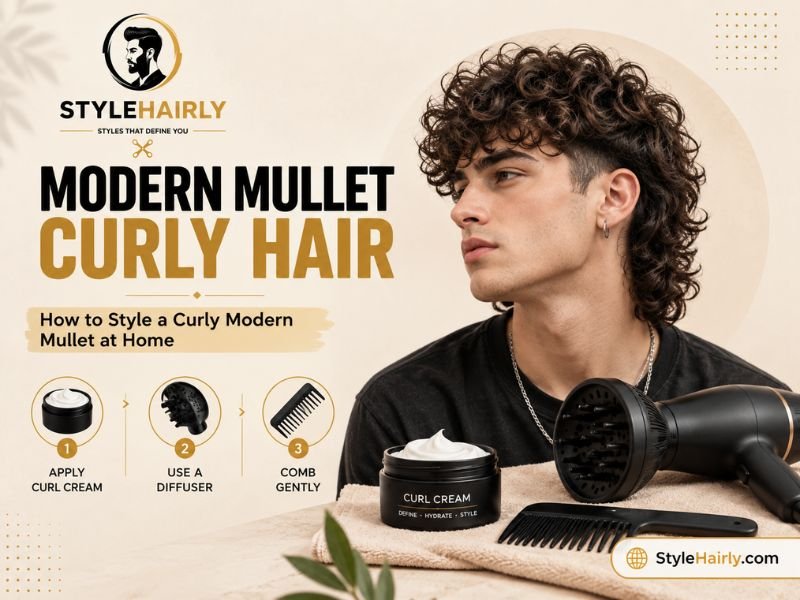
- Preparation: Start with clean, conditioned hair. Apply a leave-in conditioner to damp hair to reduce frizz before adding any styling product.
- Product application: Work a curl cream or gel through hair from mid-length to ends, using a scrunching motion rather than raking through, which helps preserve curl clumps.
- Drying: Air-dry for a natural finish, or use a diffuser attachment on low heat for more defined, voluminous curls. Always use a heat protectant if applying any heat.
- Shaping: Once mostly dry, scrunch the crown gently for volume and separate any curls that have clumped too tightly using your fingers, not a brush.
- Finishing: For extra hold, especially on longer or fluffier variations, apply a small amount of curl-friendly hairspray or a light-hold paste to the ends only.
Maintenance and Growing Out the Cut
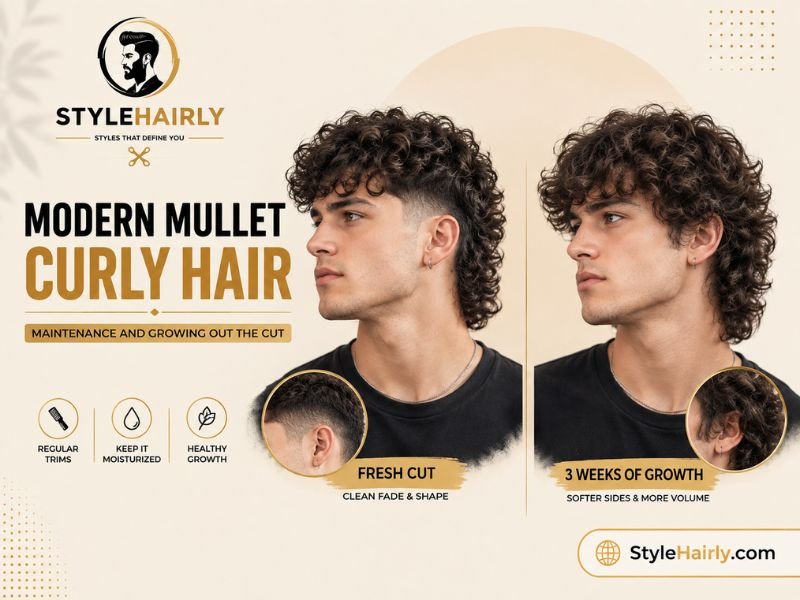
Plan on a fade touch-up every 2 to 3 weeks, since the fade line on curly hair tends to soften and blur faster than it does on straight hair as new growth comes in. Top and back trims can typically wait 6 to 10 weeks depending on the specific variation, with shorter and more heavily layered styles needing more frequent shaping than longer, less structured ones.
If you’re growing out the mullet into a different style later, expect a transitional period where the fade grows out unevenly before the sides and top reach a similar length. Regular trims during this phase, focused on blending rather than cutting for shape, make the transition look intentional rather than unkempt.
Frequently Asked Questions
Is a modern mullet good for curly hair? Yes, curly hair often works especially well with a modern mullet because the natural volume and texture highlight the layering and fade in a way straight hair can’t replicate as easily.
Does a curly mullet work with thin or fine hair? It can, but a shorter, less heavily layered version paired with a low fade usually looks fuller than a long or heavily thinned variation, which can look sparse on fine curls.
What face shape suits a curly modern mullet best? Oval and heart-shaped faces have the most flexibility, while round and square faces often do better with added crown height and a mid or skin fade to avoid extra width at the sides.
Is a curly modern mullet high maintenance? The fade needs attention every 2 to 3 weeks, which is more frequent than a non-faded mullet, but the top and back sections are generally low maintenance between trims.
How do I style a curly modern mullet at home? Apply a leave-in conditioner and curl cream to damp hair, then either air-dry or diffuse on low heat while scrunching for volume, finishing with a light-hold product if needed.
What should I ask my barber for? Specify the exact fade type and height, how much length to leave on top and in the back, and whether you want more or less layering based on your curl density.
How long does the cut last before it needs reshaping? The fade typically needs a refresh every 2 to 3 weeks, while the top and back layering usually holds its shape for 6 to 10 weeks depending on the variation.
Conclusion
A modern mullet on curly hair comes down to two decisions: which fade suits your hair density and maintenance preference, and which top and back variation matches your curl pattern and face shape. Thicker, well-defined curls generally have room to go longer and more textured, while finer or looser curls often look cleaner in shorter, more lifted variations. Whatever combination you choose, being specific with your hairstylist about fade height, length, and layering is what turns a general idea into a cut that actually works with your curl pattern rather than against it.
