

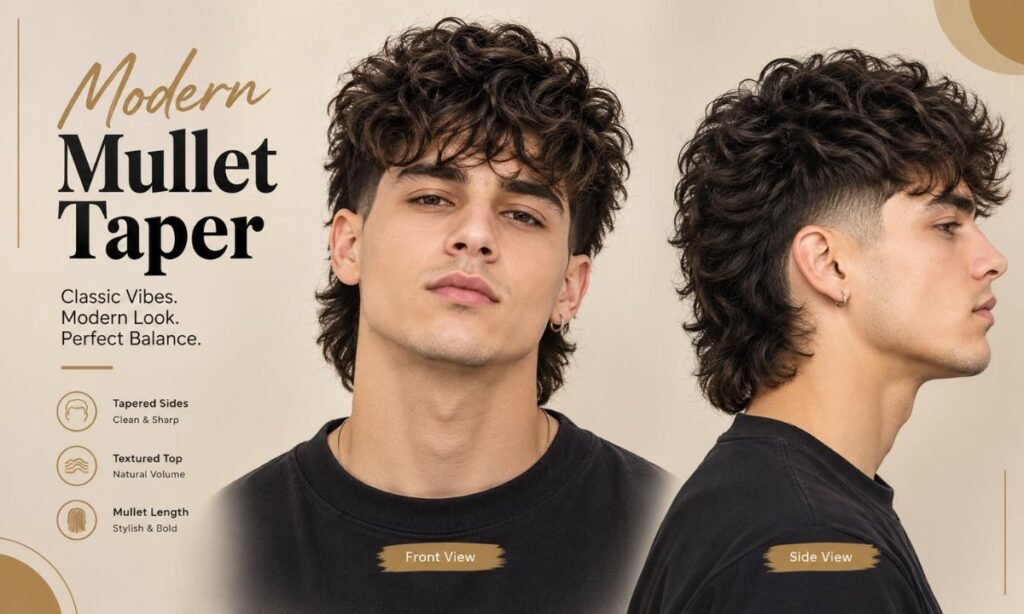
Searching for a modern mullet taper usually means you already like the mullet shape but want the sides to look cleaner and more wearable than the classic version. You are probably trying to figure out how short the sides should go, whether a low, mid, or high taper suits your face and hair type, and how much upkeep the style actually needs before you commit to it at the barbershop.
The short answer is that a modern mullet taper blends short, faded or tapered sides into a longer, textured top and a longer back section, so the haircut looks intentional and groomed instead of retro or disconnected. The taper height you choose changes how bold or subtle the contrast looks, and your hair texture affects how much styling the top actually needs.
This guide walks through what a modern mullet taper is, which hair types and face shapes it works best on, how to style and maintain it, what to say to your barber, and how the most common taper variations (low, mid, high, curly, straight, and more) compare to each other so you can pick the right version for your hair.
Modern Mullet Taper at a Glance
- Best for: hair with at least some natural texture or wave, medium to thick density, and people who want a mullet that still looks work-appropriate
- Hair length: short to medium sides, longer through the top and noticeably longer at the back and nape
- Hair types: adaptable to straight, wavy, and curly hair, though the exact taper height and top length usually need to be adjusted for texture
- Maintenance: the taper generally needs a trim every three to four weeks to stay sharp; the top and back can go longer between cuts
- Styling: typically blow-dried with a round brush for volume or air-dried with a texture product for a more relaxed look
- Main feature: the sides fade or taper cleanly into the skin or a short guard length, while the top and back keep the classic mullet length and movement
What Is a Modern Mullet Taper?
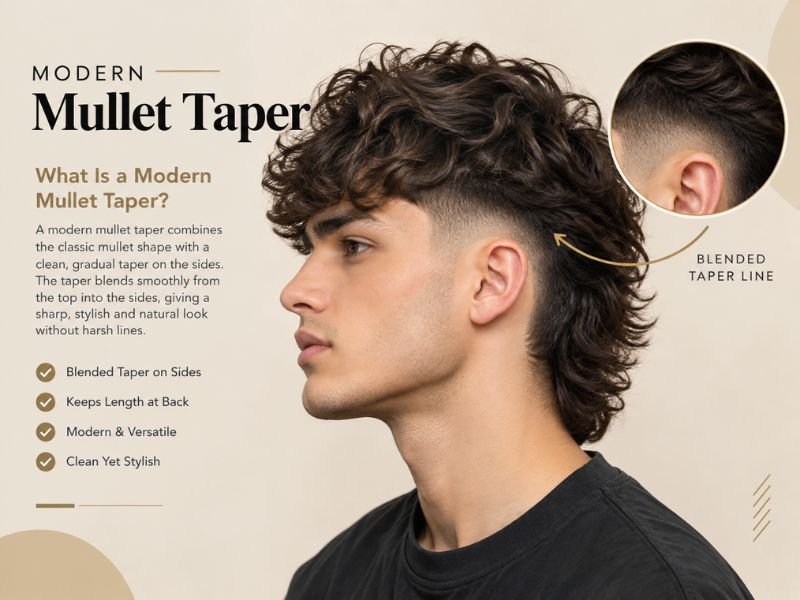
A modern mullet taper is a mullet haircut where the sides are cut with a gradual taper, meaning the hair shortens smoothly from the top down toward the skin or a very short guard length, instead of being cut bluntly or left shaggy the way many 1980s mullets were. The top stays longer for texture and movement, and the back is left noticeably longer than the sides, which keeps the signature mullet silhouette intact.
The main difference between this and a classic mullet is blending. Classic mullets often have a visible line where the short sides meet the long top, which is part of what gives the retro version its rougher look. A modern mullet taper removes that hard line and replaces it with a smooth gradient, so the haircut reads as more polished and closer to a standard fade with mullet-length hair on top, rather than a costume-style throwback cut.
Because the taper does most of the “shaping” work at the sides, the top and back can be customized in a lot of ways. Some people keep the top short and textured for an easy, low-effort look. Others grow the top and back out longer for more of a shag-mullet hybrid with heavier layering and movement.
Which Hair Types Work Best With a Modern Mullet Taper?
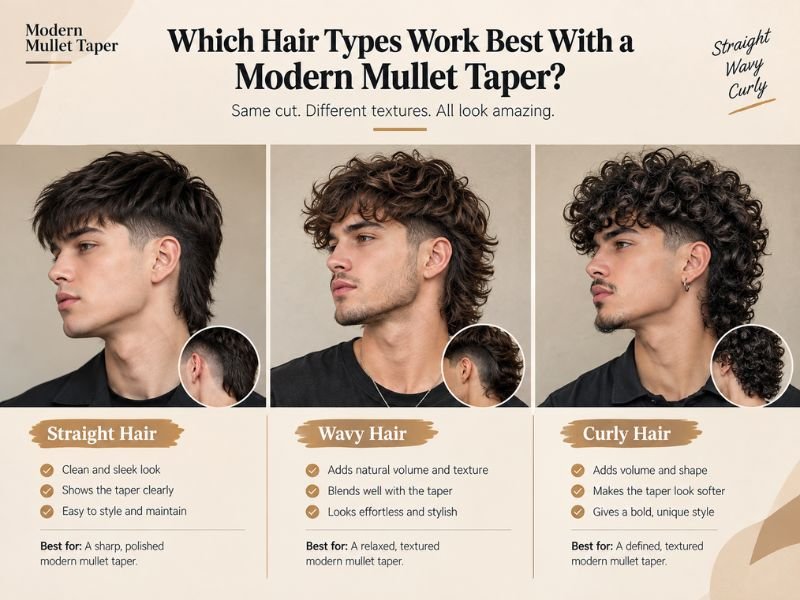
Most hair types can wear a modern mullet taper, but the texture of your hair changes how the top behaves and how often the taper needs upkeep to look clean.
| Hair Type | How It Typically Works | What to Watch For |
| Straight hair | Shows the taper line clearly and gives a sleek, defined look on top | Fine straight hair can look flat without some layering or a texturizing product |
| Wavy hair | Adds natural movement to the top and back without much extra styling | Waves can look uneven if the barber does not layer the length consistently |
| Curly hair | Creates natural volume and a fuller silhouette, especially on top | Curls shrink when dry, so length needs to be cut slightly longer to account for shrinkage |
| Fine hair | Works well with a lower taper since there is less bulk to blend | May need lightweight products to avoid looking greasy or weighed down |
| Thick hair | Handles higher tapers well because there is enough density to contrast against | Needs regular thinning or texturizing to avoid looking bulky on top |
If your hair is fine, a lower taper often looks more balanced because there is less visual weight up top to contrast against. If your hair is thick or coarse, a mid or high taper can actually help the style look less heavy overall, since the taper removes bulk at the sides.
Best Face Shapes for a Modern Mullet Taper
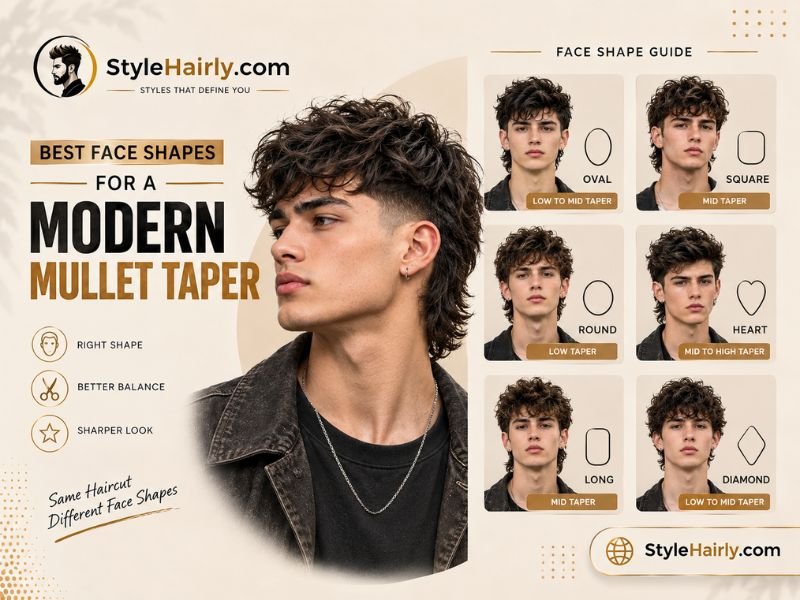
A modern mullet taper can work on most face shapes, but the taper height and top styling can be adjusted to balance specific features.
| Face Shape | What Tends to Work Well |
| Oval | Most taper heights and top lengths work well since the proportions are already balanced |
| Round | A higher taper with more height on top can help elongate the face |
| Square | A mid taper with softer, textured layers on top can soften strong jaw angles |
| Heart | A lower taper with fuller sides can balance a narrower chin |
| Long | A lower or mid taper with fringe or a side part can add width and break up length |
These are general tendencies rather than guarantees, since jawline, hairline shape, and hair density also affect how a cut sits on an individual face. A barber can usually tell within a few minutes of looking at your hairline and face shape which taper height will look most balanced.
How to Style a Modern Mullet Taper
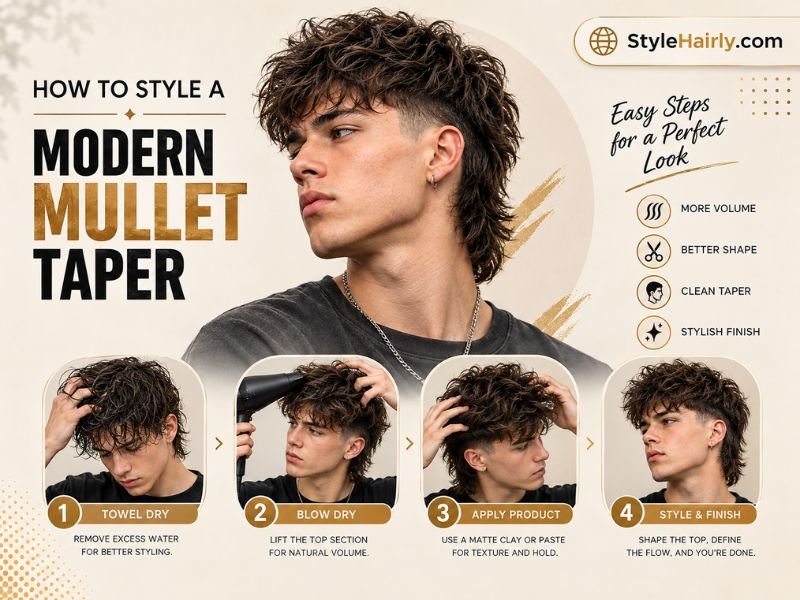
Styling a modern mullet taper is mostly about managing the top and back length, since the tapered sides need little more than regular maintenance to stay clean.
- Prep the hair. Start with clean, towel-dried hair. Apply a lightweight heat protectant if you plan to blow-dry, especially on finer or color-treated hair.
- Choose your tools. A round brush and blow dryer work well for adding volume and direction to straight or wavy hair. A diffuser attachment is better for curly hair since it dries curls without disturbing the natural pattern.
- Style the top and back. Blow-dry the top up and back for volume, or push it slightly forward for a textured fringe look. Curly hair can be scrunched with a diffuser instead of brushed to avoid frizz.
- Finish with product. A matte clay or paste adds texture without shine for a more natural look. A light pomade or texture spray works well if you want more separation and movement, especially at the back.
- Maintain the tapered sides. Between trims, keep the sides brushed down or use a small amount of product to prevent flyaways, since tapered hair is short enough to stand up if left untouched.
If you use heat tools regularly, a heat protectant spray is worth adding to the routine, since repeated blow-drying without protection can dry out the hair over time, particularly on the longer top and back sections.
Modern Mullet Taper Maintenance and Trim Schedule
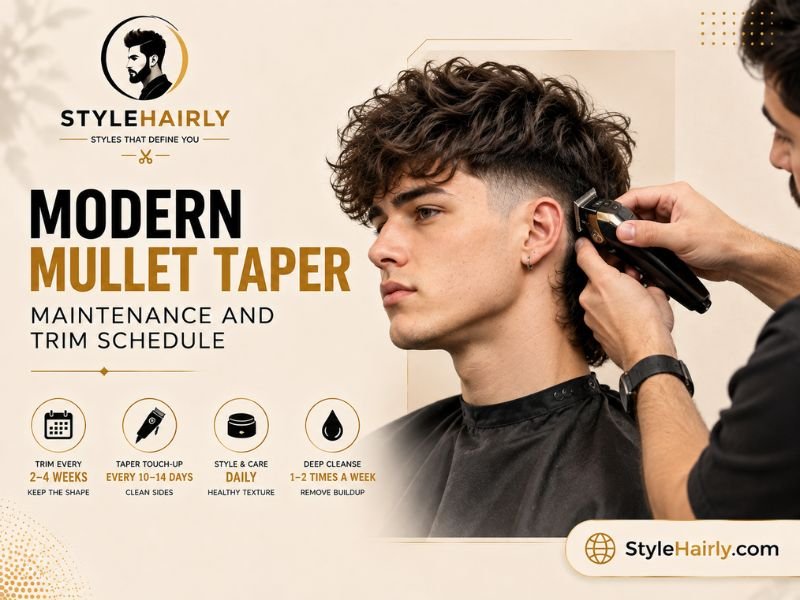
The tapered sides are the part of this haircut that needs the most frequent attention. As hair grows, the taper line shifts and starts to look shaggy or uneven rather than smooth, so most people book a trim every three to four weeks to keep the fade sharp.
The top and back can go significantly longer between visits, often six to ten weeks or more, since the mullet shape is designed to grow out with length rather than lose its shape. Many people alternate between quick “taper only” appointments and full haircuts where the top gets shaped as well.
If you have curly or coily hair, it is worth mentioning to your barber that curls shrink as they dry, since a taper that looks correct on wet hair can appear shorter or patchier once it dries and the curl pattern sets in.
Pros and Cons of a Modern Mullet Taper
Pros
- Looks more polished and versatile than a classic, unblended mullet
- The tapered sides are relatively low maintenance between trims compared to fully shaved designs
- Works across straight, wavy, and curly textures with small adjustments
- Easy to dress up or down depending on how the top is styled
Cons
- The taper needs trims every few weeks to avoid looking grown-out or uneven
- Thick or coarse hair on top may need regular thinning to avoid looking bulky
- Not every workplace or setting is a fit for the longer back length
- Curly hair requires extra attention to length so the taper does not look patchy as curls shrink
What to Tell Your Barber for a Modern Mullet Taper
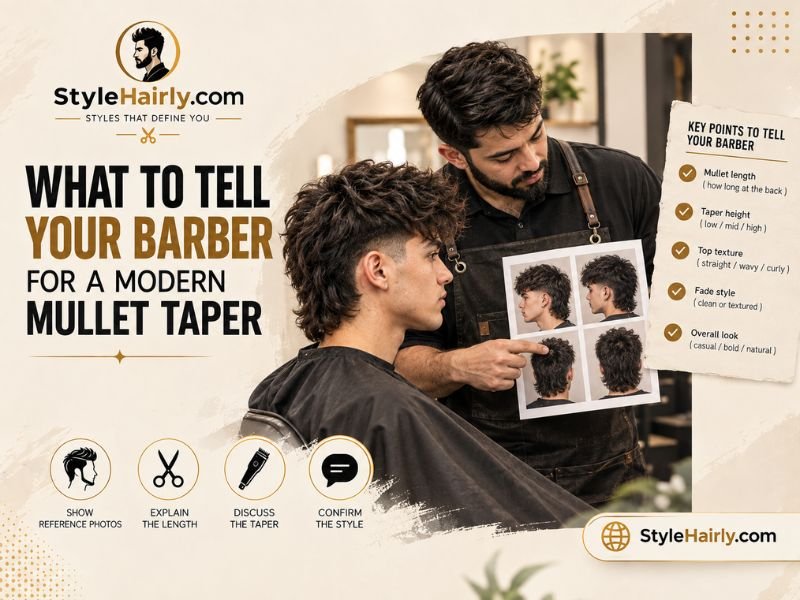
Getting the result you want mostly comes down to being specific about taper height and how much length you want to keep on top and at the back.
- Taper height: say clearly whether you want a low, mid, or high taper, or ask the barber to recommend one based on your hair density
- Top length: specify roughly how long you want the top, using a length in inches or a reference photo if possible
- Back length: mention how long you want the classic mullet length at the back and nape, since this is what separates the style from a standard taper haircut
- Texture on top: let the barber know if you want heavier texture and separation or a smoother, more uniform look
- Fringe or no fringe: decide in advance whether you want a textured fringe at the front or want the top pushed straight back
- What to avoid: mention if you want to avoid a hard line between the taper and the top, since this is what keeps the cut looking modern rather than retro
A barber cannot guarantee an identical result to a reference photo, since hair density, growth pattern, and cowlicks all affect the final shape, but giving this level of detail makes it far easier to get close to what you have in mind.
Once you understand the basics of a modern mullet taper, the style branches out into several variations depending on taper height, hair texture, and how much of the classic mullet shape you want to keep. Here is how the most common versions compare.
Modern Mullet Low Taper Fade
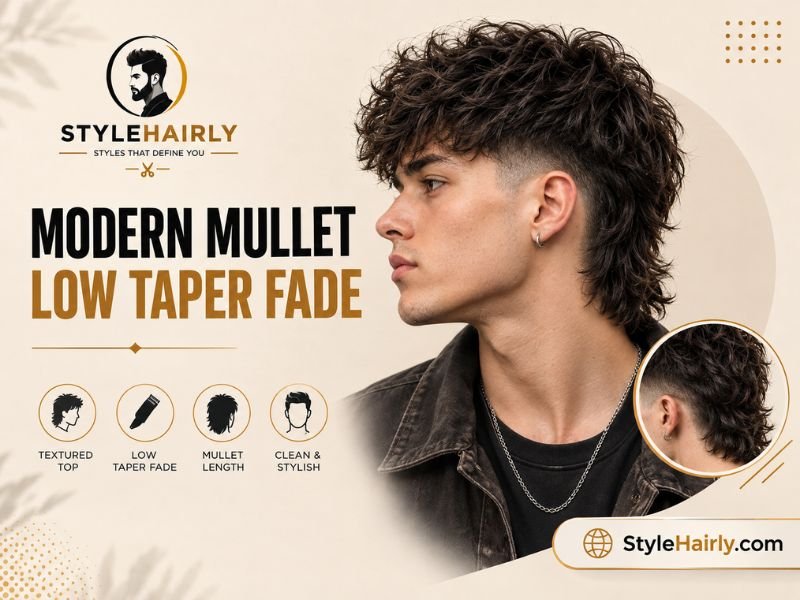
A modern mullet low taper fade keeps the fade close to the hairline, starting the gradient just above the ears and neckline rather than climbing higher up the head. It is the most subtle version of the taper family, which makes it a common choice for people who want the mullet shape without a lot of visible contrast at the sides.
Best For: people who want a subtle, low-contrast look or need a style that reads as professional in most workplaces Styling Tip: because the sides stay close to the natural hairline, most of the styling attention should go into adding volume and shape to the top Maintenance: low tapers grow out more gradually than higher ones, so trims every four to five weeks are often enough to keep the line clean
Modern Mullet Mid Taper Fade
A mid taper fade raises the gradient a bit higher, usually starting around temple level, which creates more visible contrast between the short sides and the longer top than a low taper does. It is often described as the middle ground between a subtle low taper and a bold high taper.
Best For: people who want noticeably shorter sides without going as dramatic as a high taper Styling Tip: a mid taper pairs well with textured, tousled styling on top since the extra contrast at the sides already does a lot of the visual work Maintenance: expect to book trims slightly more often than a low taper, roughly every three to four weeks, since the higher fade line grows out faster visually
High Taper Modern Mullet
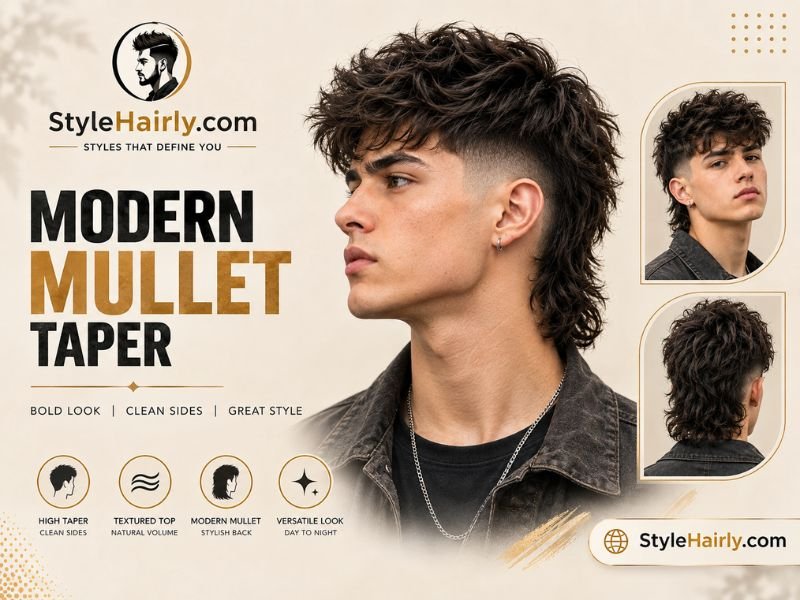
A high taper modern mullet moves the fade line up near the crown, creating the most dramatic contrast between the sides and the long top and back. This version leans closer to a full fade with mullet length left on top, which gives it a bolder, more edgy appearance.
Best For: people who want maximum contrast and are comfortable with a more attention-grabbing style Styling Tip: since the sides are cut so short, styling should focus almost entirely on building height and texture through the crown and back Maintenance: high tapers show growth the fastest of the three heights, so trims every two to three weeks help keep the line sharp
Short Modern Mullet Taper
A short modern mullet taper reduces the overall length on top and at the back compared to a standard mullet, keeping the whole haircut closer to the head while still preserving the layered, longer-in-back shape that defines a mullet.
Best For: first-timers who want to try the mullet shape without committing to a lot of length, or people with thinner hair who want less bulk Styling Tip: shorter length needs less product; a small amount of matte paste is usually enough to add texture without weighing the top down Maintenance: shorter mullets need slightly more frequent trims overall since there is less length to disguise growth between visits
Blowout Taper Modern Mullet
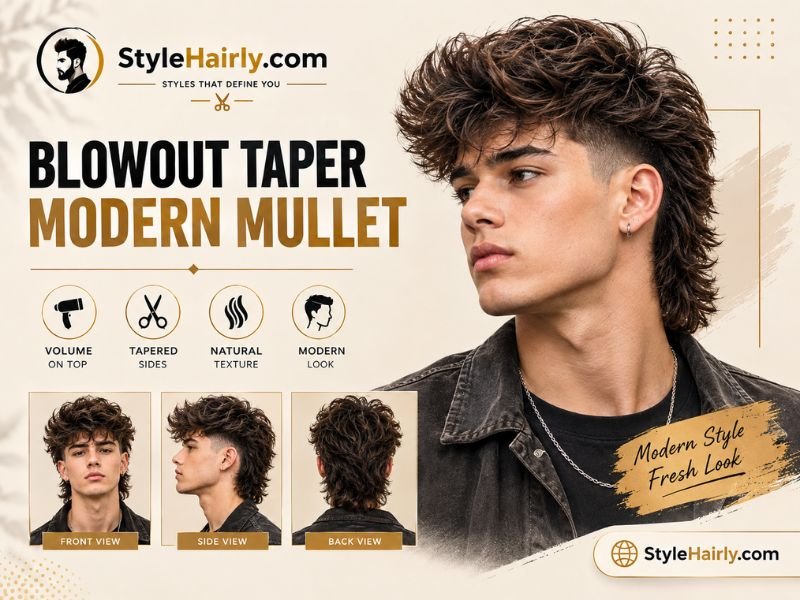
A blowout taper modern mullet pairs the tapered sides with a voluminous, blown-out top that is dried upward and back for height, rather than styled flat or forward. The blowout technique is what gives this version its noticeably fuller, rounder silhouette on top.
Best For: thicker or coarser hair types that naturally hold volume, since fine hair may need extra product to hold a full blowout shape Styling Tip: dry the top on a medium heat setting using a round brush, lifting the roots upward and away from the scalp for lasting volume Maintenance: the blowout is a daily styling step rather than a maintenance task, so plan for a few extra minutes with a blow dryer each morning
Modern Mullet With Low Taper
This version emphasizes keeping the taper as understated as possible while still calling the cut a “taper” rather than a fully blended, seamless side. The distinction from a standard low taper fade is subtle, often coming down to whether the barber uses clippers only or blends in some scissor work near the top for a softer transition.
Best For: people who want the cleanest possible sides without any hard lines or visible fade contrast Styling Tip: ask your barber to blend the taper into the top using scissors rather than clippers alone for an even softer transition Maintenance: this softer blend tends to grow out gracefully, so trims can often be spaced slightly further apart than a clipper-only low taper
Low Taper Modern Mullet Straight Hair
On straight hair, a low taper modern mullet shows off a very clean, defined line between the tapered sides and the longer top, since straight strands lie flat and highlight the cut’s shape clearly. The top typically needs some help to avoid looking flat.
Best For: straight hair that is medium to thick in density, since fine straight hair can look sparse without added texture Styling Tip: use a texturizing spray or light clay and rough-dry the top with your fingers to break up the straight, flat finish Maintenance: straight hair shows regrowth at the taper line quickly, so trims every three to four weeks help keep the transition smooth
Low Taper Modern Mullet Curly Hair
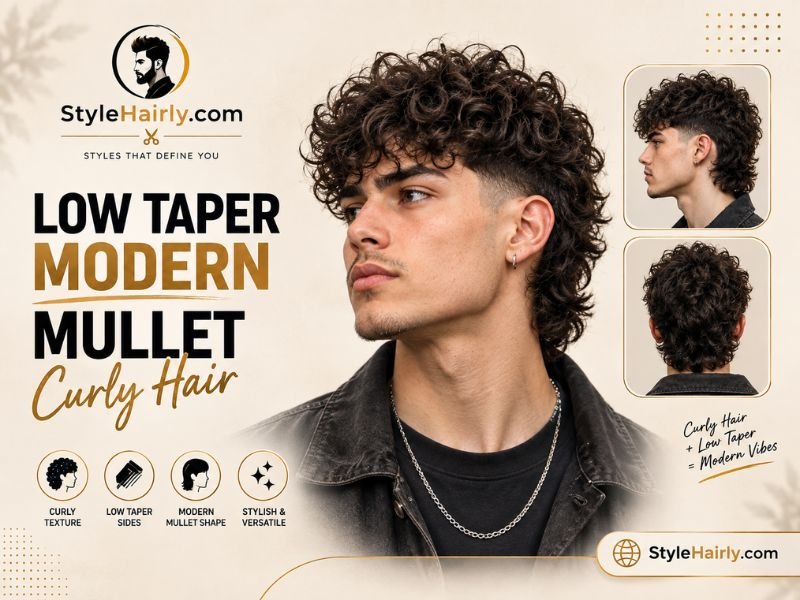
Curly hair adds natural volume and definition to a low taper modern mullet without much extra styling effort, since the curl pattern already creates texture on top. The main consideration is that curls shrink significantly as they dry, so the length needs to be judged carefully.
Best For: naturally curly or coily hair types that want to keep more definition and less contrast at the sides Styling Tip: apply a curl cream to damp hair and diffuse on low heat to encourage defined curls without frizz Maintenance: ask your barber to cut curls slightly longer than the intended finished length to account for shrinkage once the hair fully dries
Modern Mullet with Side Taper
A modern mullet with a side taper focuses the tapering specifically along the sides of the head, while the back may be left with more of its natural length and shape rather than being tapered to match. This creates a slightly asymmetrical feel between the tightly tapered sides and the fuller back.
Best For: people who want short, clean sides but prefer the back to keep more natural bulk and length rather than a blended taper Styling Tip: keep the back brushed or combed back so it does not compete visually with the cleaner, shorter sides Maintenance: the sides need the usual three to four week taper upkeep, while the back can typically go longer between trims
Modern Mullet Taper Fade Curly Hair
This variation combines a full taper fade with curly hair on top, which means the fade starts close to the skin and gradually lengthens into a curl pattern rather than straight or wavy hair. The contrast between the tightly faded sides and the springy curls on top tends to be very pronounced.
Best For: curly hair types who want a bolder, higher-contrast look rather than a subtle blend Styling Tip: avoid brushing dry curls, since this can cause frizz; instead, finger-style with a curl-defining product while hair is still damp Maintenance: because curls can hide new growth at the fade line for a while, many people stretch trims slightly longer than straight-haired versions, though the fade itself still needs regular upkeep to stay crisp
Modern Mullet Textured Fringe Low Taper
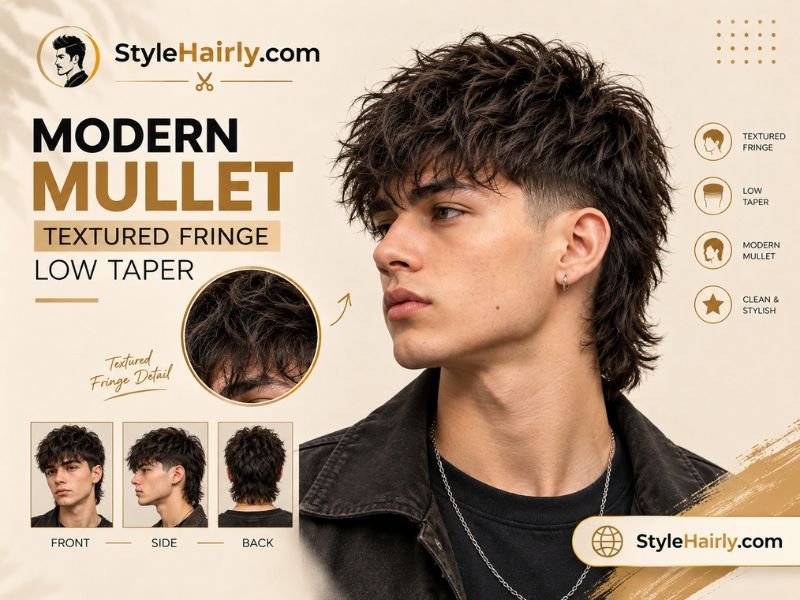
This version pairs a subtle low taper with a textured fringe at the front, meaning the top hair is cut and styled to fall forward with visible piece-y separation rather than being swept straight back. It softens the overall look and draws attention to the front of the hairstyle.
Best For: people who want a softer, face-framing element at the front rather than an all-back or upward style Styling Tip: apply a small amount of matte paste to dry hair and use your fingers to separate the fringe into individual pieces Maintenance: fringe length needs more frequent trims than the rest of the top if you want it to keep sitting right above the eyebrows or wherever you prefer it
Mid Taper Modern Mullet Curly Hair
A mid taper modern mullet on curly hair balances a noticeable but not extreme fade height with the natural volume curls provide on top. The combination often looks fuller than the same taper height on straight hair, since curls take up more visual space.
Best For: curly hair types who want visible contrast at the sides but still want the top to feel full and voluminous Styling Tip: scrunch a lightweight gel or curl cream into damp hair and let it air-dry or diffuse to preserve curl definition without added bulk Maintenance: keep an eye on the mid taper line specifically, since curls can start looking uneven at the transition point faster than they do further up
Modern Mullet Taper Curly Hair
As a broader category, modern mullet taper curly hair simply refers to any taper height paired with naturally curly hair on top and at the back. The unifying theme across low, mid, and high versions is that curl pattern, porosity, and shrinkage all play a bigger role in the final look than they do on straight or wavy hair.
Best For: anyone with type 2c to 4c curl patterns who wants a mullet taper but is unsure which taper height fits their curl density Styling Tip: ask your barber which taper height they recommend based on how tightly your curls coil, since tighter curls can sometimes handle a slightly higher taper without looking too sparse Maintenance: curly hair often benefits from a consultation every few visits to reassess length and shrinkage, not just a routine trim
Modern Mullet Low Fade
A modern mullet low fade is closely related to a low taper but typically refers to a slightly more blended, skin-close finish right at the hairline, rather than stopping at a short guard length. The visual difference from a low taper is subtle but noticeable up close.
Best For: people who want the sides to fade all the way to the skin near the hairline rather than stopping at a short clipper guard Styling Tip: because the fade goes closer to the skin, keep the top styling simple so it does not compete with the cleaner finish at the hairline Maintenance: skin-close fades typically need trims slightly more often than guard-only tapers, since regrowth is more visible against bare skin
Modern Mullet Taper Men
This phrasing generally refers to the men’s version of the modern mullet taper as a broad category, covering the range of taper heights and lengths already discussed rather than one specific look. It is often used by people comparing general options before deciding on a specific taper height.
Best For: anyone starting their research and trying to understand the general range of modern mullet taper options before picking specifics Styling Tip: bring a couple of reference photos showing different taper heights to your consultation so your barber can help narrow down what suits your hair Maintenance: maintenance expectations vary by the specific taper height and length chosen, so confirm a trim schedule with your barber once you settle on a style
Low Taper Mullet
A low taper mullet is essentially shorthand for the same low taper modern mullet discussed earlier, often used interchangeably in searches even though “modern” is sometimes dropped from the phrase. The style itself stays the same: a subtle, close-to-the-hairline taper with a longer mullet shape on top and at the back.
Best For: anyone who prefers understated, low-contrast sides regardless of how the search term is phrased Styling Tip: the low fade line is forgiving, so this variation works well for people who are new to styling a mullet and want fewer things to manage Maintenance: as with other low tapers, trims every four to five weeks generally keep the shape looking intentional rather than overgrown
Modern Mullet Fade
Used broadly, a modern mullet fade covers any version of the style where the sides transition into a true fade rather than a clipper-guard taper, regardless of the height. The key distinction from a taper is that a fade blends all the way to the skin at some point along the gradient.
Best For: people who specifically want a skin-level fade rather than a taper that stops at a guard length Styling Tip: ask your barber directly whether you want a “taper” or a “fade,” since the two terms are often used loosely but describe slightly different finishes Maintenance: true skin fades generally need more frequent upkeep than guard tapers because regrowth shows up faster against bare skin
Fade Mullet Haircut
A fade mullet haircut is another common way of describing the same general style, where the emphasis in the search phrase is on the fade element rather than the mullet shape itself. It typically refers to the same family of cuts already covered under the fade and taper variations above.
Best For: people searching more generally for how a fade looks combined with mullet length, without a specific taper height in mind yet Styling Tip: narrowing down a taper height (low, mid, or high) before your appointment makes the consultation faster and the result more predictable Maintenance: maintenance follows whichever specific fade height you choose, so treat this as a starting search term rather than a distinct style
Mullet Taper Fade
Similar to the previous two entries, a mullet taper fade usually describes the combination of a tapered or faded side with mullet-length hair on top, without specifying an exact height. It is one of the most commonly searched general phrases for this style family.
Best For: anyone comparing general options before deciding between a low, mid, or high taper fade specifically Styling Tip: use this broader research phase to collect a few reference photos at different taper heights so you can show your barber what you like and dislike Maintenance: general maintenance expectations mirror whichever specific taper height is eventually chosen
Mid Taper Mullet
A mid taper mullet refers to the same mid-height fade discussed earlier in more detail, sitting between the subtlety of a low taper and the boldness of a high taper. It remains one of the more versatile choices since it works across a wide range of hair densities and face shapes.
Best For: people who want a noticeable but balanced amount of contrast at the sides without going to either extreme Styling Tip: a mid taper pairs well with either a smooth, combed-back top or a more textured, tousled finish, so it adapts to different styling moods Maintenance: plan for trims roughly every three to four weeks to keep the mid-height line from blending upward as hair grows
Modern Mullet Without Taper
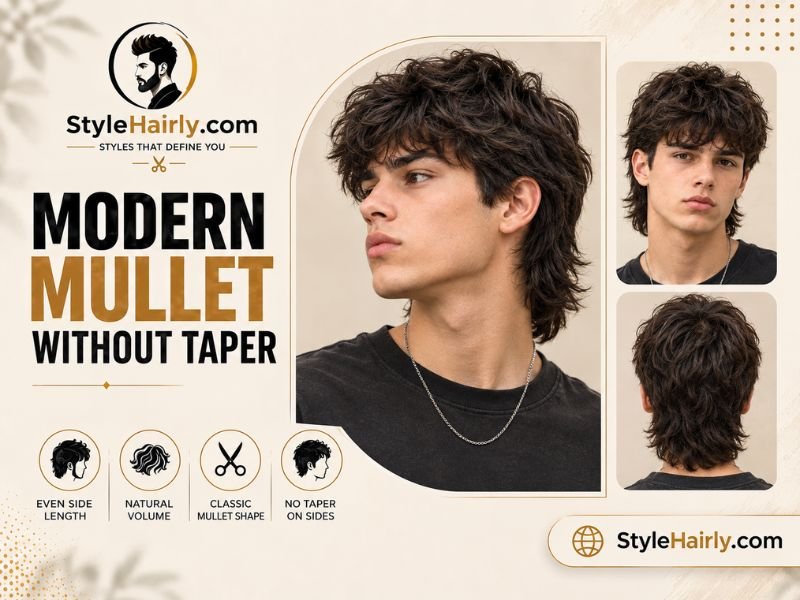
A modern mullet without a taper skips the gradual blend at the sides entirely, instead using a more uniform length around the sides and back that is simply shorter than the top, without clippers creating a gradient. This version looks closer to a classic mullet but still keeps the “modern” styling and layering on top.
Best For: people who prefer a lower-maintenance side length that does not need frequent taper touch-ups, or who want a look closer to the original mullet aesthetic Styling Tip: because there is no taper line to maintain, styling attention can go entirely into shaping and texturizing the top and back Maintenance: without a taper to maintain, trims can typically be spaced further apart, often six to eight weeks, focused mainly on shape rather than a fade line
Modern Mullet Taper vs Other Popular Hairstyles
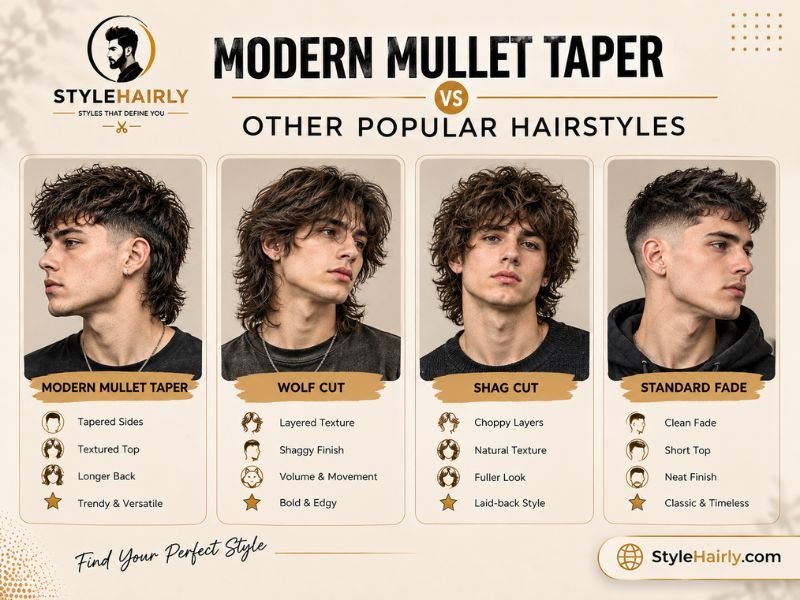
Comparing a modern mullet taper to other popular cuts can help clarify whether it is the right choice compared to a similar alternative.
| Style | Overall Look | Maintenance | Best Suited Hair |
| Modern Mullet Taper | Short tapered sides, long textured top and back | Taper trims every 3-4 weeks | Works across straight, wavy, and curly hair |
| Classic Mullet | Blunt, unblended sides with long back | Lower maintenance, grows out less noticeably | Best on straight to wavy hair |
| Wolf Cut | Heavily layered mullet-shag hybrid with lots of texture | Needs regular layering trims to maintain shape | Works especially well on wavy and curly hair |
| Shag Cut | Choppy layers throughout with no distinct short-side taper | Lower maintenance since there is no fade line | Suits most hair types, especially textured hair |
| Standard Fade | Skin-close sides blending into a short top | Frequent trims needed, every 2-3 weeks | Best on straight to slightly wavy hair |
The main advantage of a modern mullet taper over a classic mullet or shag is the cleaner side profile, which makes it easier to wear in more settings. Compared to a standard fade, the payoff is the longer, more expressive top and back, at the cost of a bit more daily styling time.
Frequently Asked Questions
Is a modern mullet taper good for thin hair?
Yes, but a lower taper height often works better on thin hair, since there is less bulk at the sides to contrast against a thinner top. Adding light texturizing on top can also help the hair look fuller.
Does a modern mullet taper work on curly hair?
Yes. Curly hair adds natural volume on top, and the taper can be adjusted in height depending on curl density. It is worth telling your barber that curls shrink when dry so the length is cut with that in mind.
What taper height should I choose for a modern mullet?
It depends on how much contrast you want and how your hair handles length. Low tapers suit subtle, professional looks, mid tapers balance contrast and versatility, and high tapers create the boldest, most dramatic effect.
Is a modern mullet taper high maintenance?
The tapered sides need trims roughly every three to four weeks to stay sharp, which is more frequent than a classic mullet but less demanding than a full skin fade. The top and back can go much longer between cuts.
How do I style a modern mullet taper at home?
Blow-dry or diffuse the top for volume and texture, then finish with a matte paste or light pomade. The tapered sides need little styling day to day beyond keeping them brushed down or lightly product-free.
What should I ask my barber for?
Be specific about taper height, top length, back length, and whether you want a hard or blended line between the taper and the top. Bringing a reference photo helps, but results can vary based on your natural hair density and growth pattern.
How long does a modern mullet taper last before it needs reshaping?
The taper itself typically needs a touch-up every three to four weeks, while the overall mullet shape can often go six to ten weeks before the top and back need reshaping.
Can straight hair pull off a modern mullet taper?
Yes, straight hair actually shows the taper line very clearly, which gives the cut a crisp, defined look. The top usually needs a texturizing product to avoid looking flat since straight hair lies close to the head.
Conclusion
A modern mullet taper works because it takes the boldest, most recognizable part of the mullet, the long back and textured top, and pairs it with tapered sides that look deliberate rather than dated. The taper height you choose has the biggest impact on how subtle or bold the final look reads, while your hair texture determines how much daily styling the top actually needs.
If you are unsure where to start, a low or mid taper is usually the safer choice for a first attempt, since both are easier to grow out or adjust later compared to a high taper. From there, the specific variation, whether that is a curly taper, a textured fringe, or a fully faded finish, comes down to personal preference and how much upkeep you are willing to commit to. Bringing clear reference points and being specific about taper height and length at your next barber visit is the most reliable way to get a result that actually matches what you had in mind.

2 thoughts on “Modern Mullet Taper (2026): Ultimate Guide to 25+ Styles”