

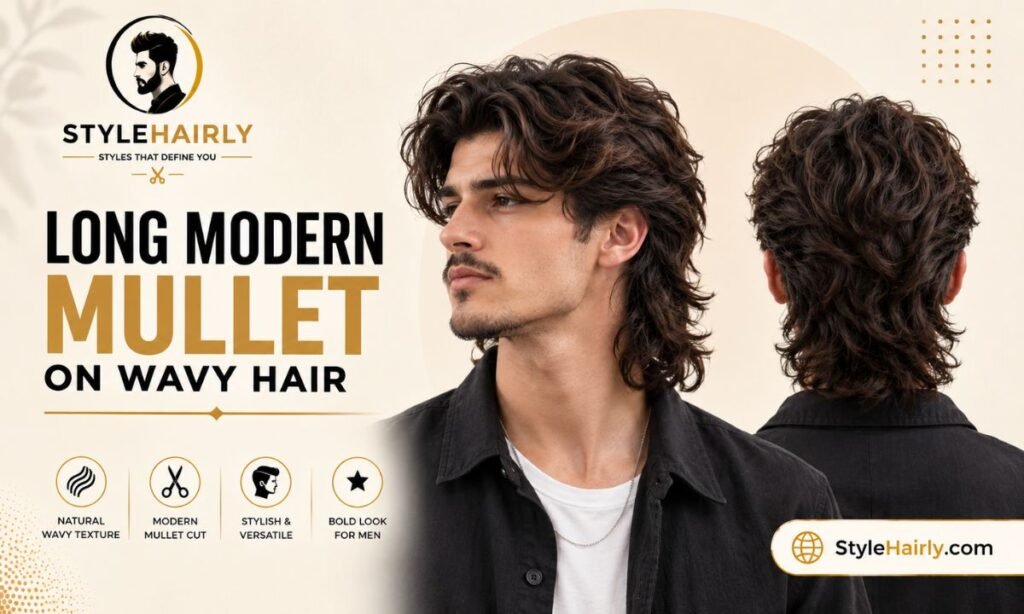
Growing out a mullet is easy to start but harder to keep looking intentional once the back reaches real length. Many people searching for a long modern mullet are trying to figure out whether their current growth stage still counts as the style, which variation actually suits their hair type, and how to stop it from turning into an unshaped mess between salon visits.
A long modern mullet works when the back is left to grow while the crown, top, and sides stay shorter and blended through layering, so the length reads as a deliberate flowing silhouette instead of hair that simply needs a cut.
The exact look changes depending on how much length is kept at the back, how the top is layered, and whether the hair is straight, wavy, or curly.
This guide covers how the long modern mullet differs from the classic version, which hair types and face shapes it suits, how to style and maintain it, and the most common variations people ask their hairstylist for, including longer-back versions, faded sides, curly and straight adaptations, and options for thick hair.
Long Modern Mullet at a Glance
Best for: hair that has already grown past the shoulders at the back or is being grown out toward that length
Hair length: medium at the crown and sides, long at the back and nape
Hair types: straight, wavy, curly, and thick hair, each with different layering needs
Maintenance: a trim or shape-up roughly every 8 to 12 weeks
Styling: air-dried texture on low-effort days, blow-dried volume and flow for a more finished look
Main feature: shorter, layered top and sides that blend into a long, flowing back section
What Is a Long Modern Mullet?
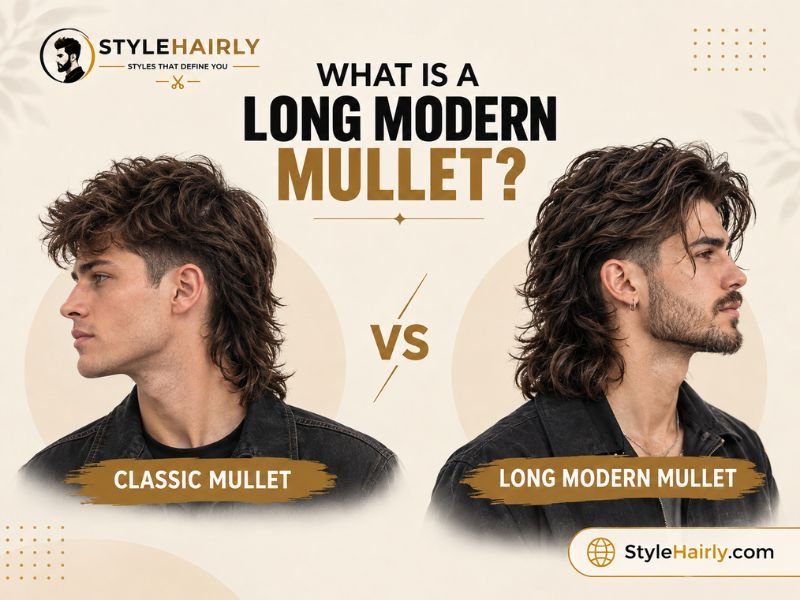
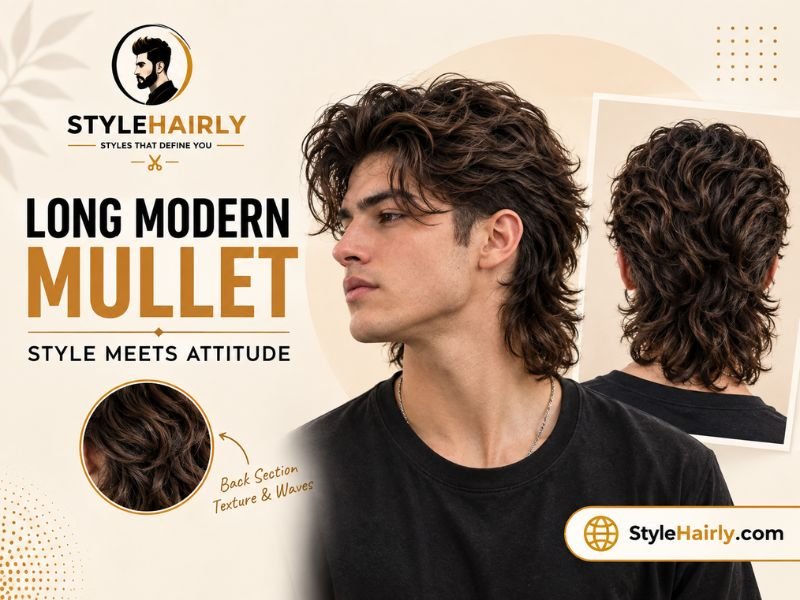
A long modern mullet is a haircut that keeps significant length at the back, often past the shoulders, while the top and sides are cut shorter and heavily layered so the transition between the two lengths looks gradual rather than abrupt. It is a direct evolution of the classic 1970s and 1980s mullet, but the modern version relies on blending and texture instead of a hard, boxy line between short and long sections.
The defining difference from the classic mullet is how the lengths connect. Older mullets often had a visible step between the short top and the long back. A long modern mullet is cut with more layers through the crown and sides so the length increases gradually, which is what gives it a shag-like, lived-in appearance rather than a retro throwback look.
Because the back is left long, this version usually takes longer to grow into and requires more patience than a shorter modern mullet. Once the length is there, though, it offers more styling options, including ponytails, half-up styles, and braided back sections that shorter mullets cannot support.
Hair Type and Texture Suitability
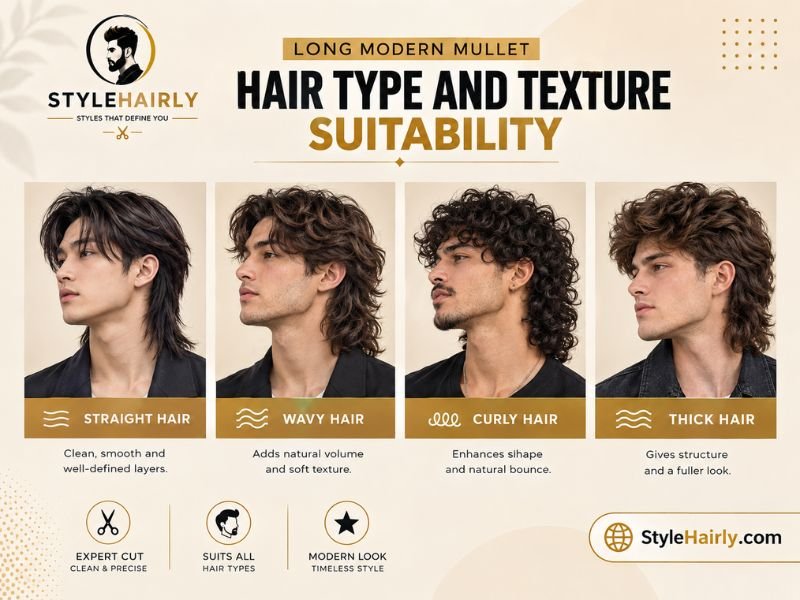
Not every hair type reaches this look the same way, and the layering approach usually needs to change based on texture and density.
Straight hair needs more deliberate layering to avoid looking flat at the crown and heavy at the back. Point cutting or texturizing shears at the ends help create separation that straight hair does not create on its own.
Wavy hair tends to suit the long modern mullet with less effort because the natural bend already breaks up the length and adds movement at the back. Fewer heavy layers are usually needed.
Curly hair benefits from careful thinning through the back and nape, since curls add visible volume and can make the long section look overly bulky if it is not thinned. The top and crown often need less removal because curls already create height.
Thick hair generally needs the most layering throughout, especially at the back, to prevent the long section from sitting as one heavy mass. Without enough layering, thick hair can make the cut look more like a long haircut with short bangs than an actual mullet.
Fine hair needs the opposite approach. Fewer, more strategic layers work better, since over-thinning fine hair can leave the back looking sparse or stringy at the ends.
Face Shape Suitability
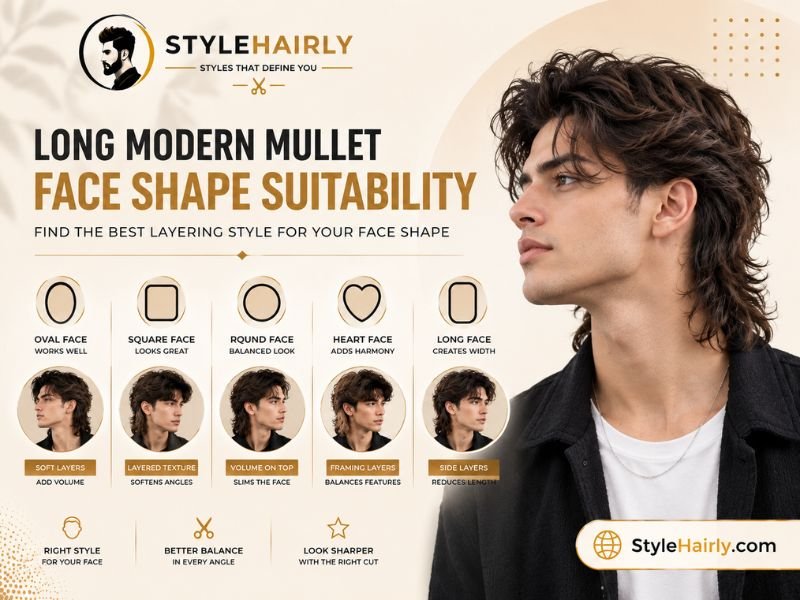
The way the top and sides are cut has more influence on face shape flattery than the length of the back.
Oval faces suit most variations of the long modern mullet without major adjustment, since the proportions are already balanced.
Round faces often look better with added height at the crown and shorter layers near the cheeks, which elongates the face rather than adding width at the sides.
Square faces tend to benefit from softer, slightly longer layers around the jawline to reduce the appearance of sharp angles.
Heart-shaped faces usually do well with face-framing pieces left slightly longer near the jaw to balance a wider forehead.
Long faces generally look best with a fuller top and less added height, since extra volume at the crown can make the face appear even longer.
How to Style a Long Modern Mullet
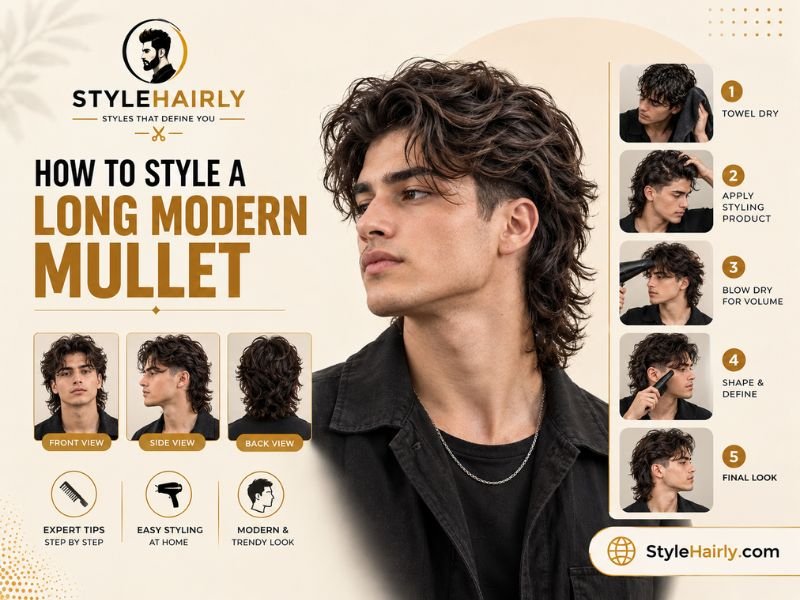
Preparation. Start on clean or second-day hair. Fully clean hair can feel too slippery to hold texture, so a light texturizing spray or dry shampoo at the roots often helps the style hold shape.
Products. A lightweight sea salt spray or texturizing cream works well for the top and crown, while a small amount of light-hold pomade or hair oil on the back section adds separation without weighing the length down.
Styling steps.
- Rough-dry the hair with fingers, lifting at the roots to build volume at the crown.
- Apply a texturizing product to the top and sides while the hair is still slightly damp.
- Use a round brush or diffuser to add movement to the crown layers if more volume is wanted.
- Twist or scrunch the back section lightly to encourage natural wave or separation.
- Finish with a small amount of oil or pomade on the ends of the back section to control flyaways.
Finishing. A light-hold flexible spray keeps the shape without making the hair feel stiff or overly styled.
Maintenance between styling sessions. A quick refresh with dry shampoo at the roots and a comb-through of the back section is usually enough to reset the look on non-wash days.
If heat styling tools are used to add curl or flow to the back section, a heat protectant spray should be applied first to reduce damage from repeated heat exposure.
Maintenance
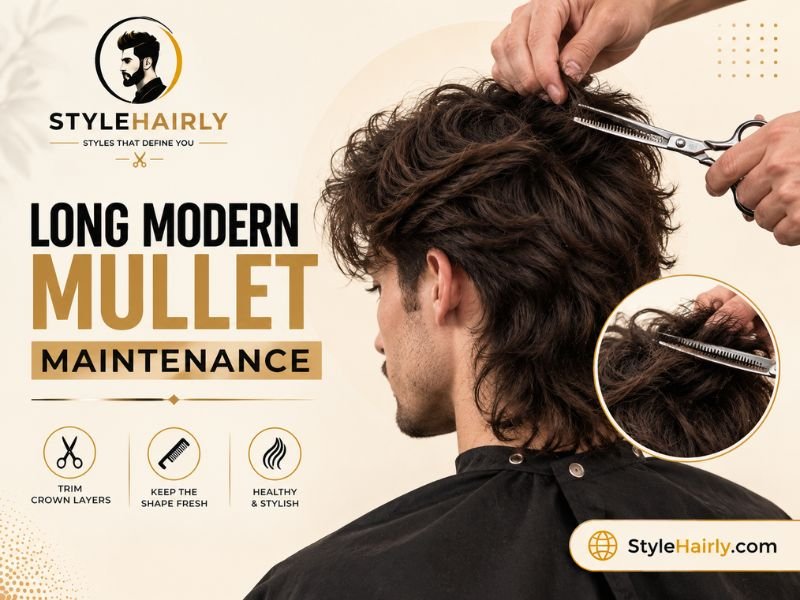
A long modern mullet needs more frequent trims than most long hairstyles because the shape depends on the relationship between the short top and long back staying consistent. Most people need a trim or shape-up every 8 to 12 weeks, even though the back itself is not being cut short.
The most common maintenance mistake is only trimming the ends of the back section and ignoring the crown and sides, which lets those areas grow out and blur the intended contrast between short and long. Regular check-ins with a stylist to reshape the shorter layers keep the mullet looking deliberate rather than simply unkempt.
Pros and Cons
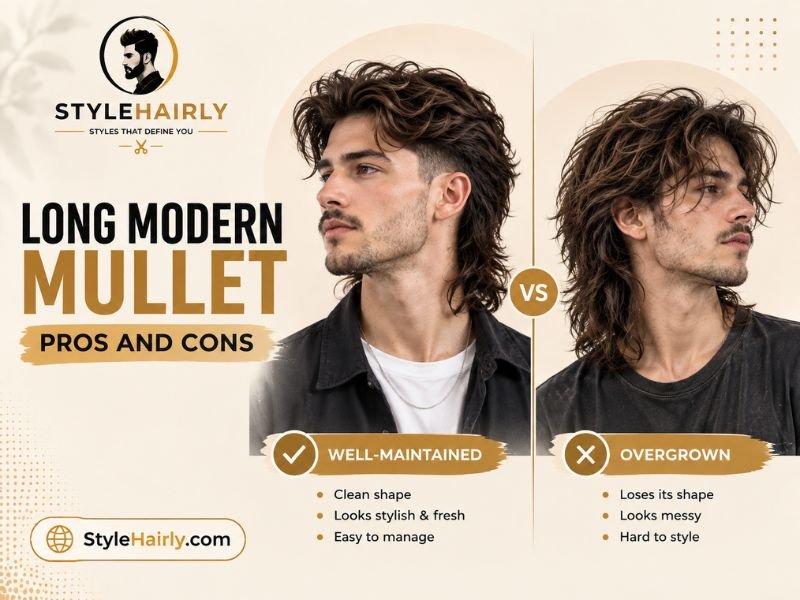
Pros
- Offers more styling versatility than a shorter mullet, including ponytails and half-up looks
- Works across straight, wavy, curly, and thick hair with the right layering
- Can be styled with minimal daily effort once the shape is established
Cons
- Requires more frequent trims to the top and sides than a typical long haircut
- Can look unintentional if the back grows out unevenly or gets too thin at the ends
- Takes longer to grow into a full silhouette compared to shorter mullet versions
Long Mullet vs Long Modern Mullet: What Is the Difference
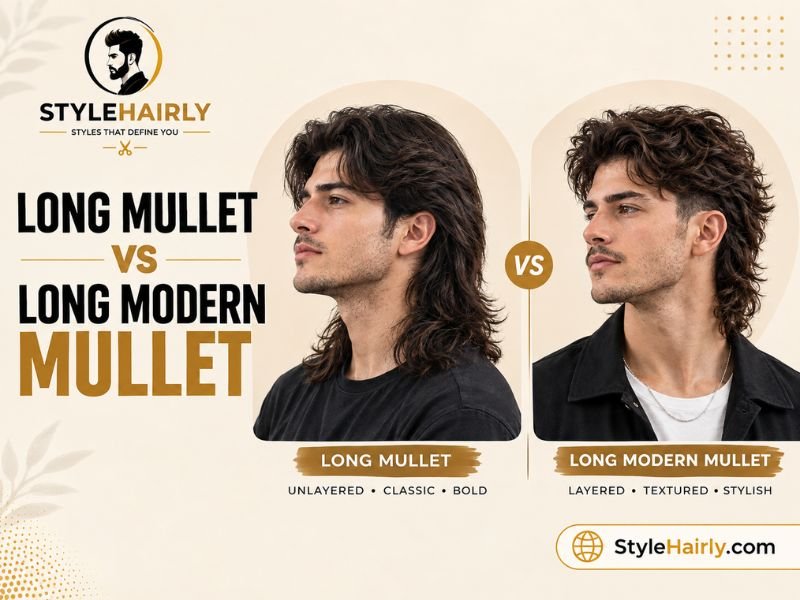
A long mullet on its own generally refers to any mullet where the back section has been allowed to grow well past the shoulders, regardless of how the top is cut. It is a length description more than a specific style.
A long modern mullet is a more refined version of that same idea. It specifically uses heavy layering and blending techniques through the crown and sides so the short-to-long transition looks gradual, rather than leaving a long back attached to a top that was never layered to match it.
Best for: anyone who already has an unshaped long mullet and wants it refined into an intentional style, rather than starting the growout process from short hair.
Styling tip: ask for the crown and sides to be re-layered even if the length at the back is left untouched. This single change is usually what turns a long mullet into a long modern mullet.
Maintenance: the same 8 to 12 week trim schedule applies, focused on the shorter sections rather than the back length.
Long Modern Mullet With a Long Back
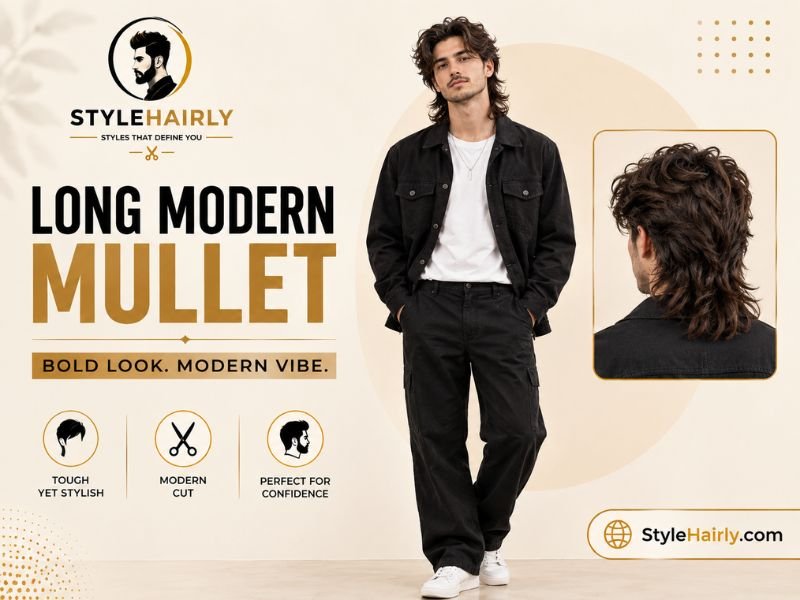
This version pushes the back section as long as possible, often reaching mid-back length, while keeping the crown and sides in a fairly standard modern mullet layering pattern. It is the variation most people mean when they search specifically for a long modern mullet, since the back length is the main visual statement.
Best for: people who have already spent significant time growing out the back and want to keep pushing the length rather than trimming it back.
Styling tip: the longer the back gets, the more it benefits from light layering through the mid-lengths, not just the ends, to prevent it from looking like one flat sheet of hair.
Maintenance: trims should focus almost entirely on the crown and sides every 8 to 12 weeks, with only occasional dusting of the back ends to prevent split ends without sacrificing length.
Long Modern Mullet With Long Hair on Top
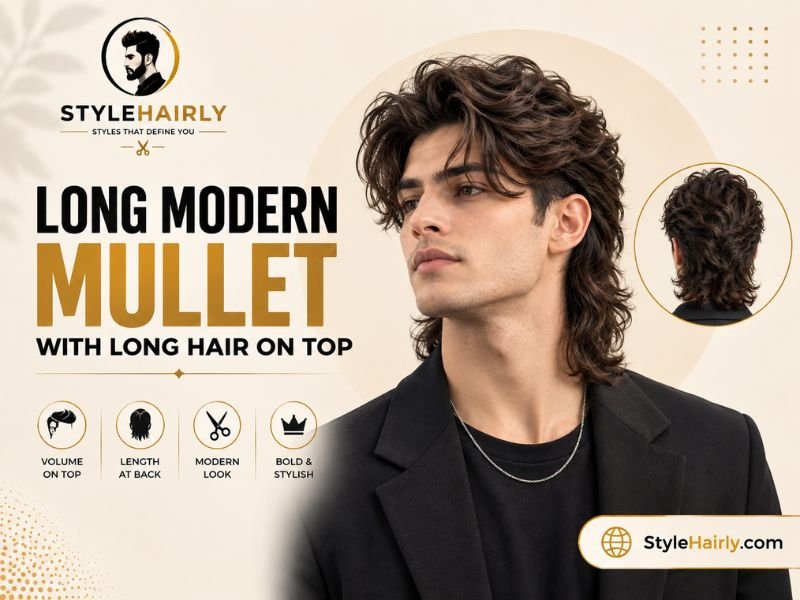
In this variation, the crown and top sections are left noticeably longer than a typical mullet, softening the contrast between the top and the long back. Instead of a short, choppy crown, the top blends more gradually into the length behind it.
Best for: people who want the mullet silhouette without a dramatically short top, or who are not ready to commit to shorter crown layers.
Styling tip: use a round brush while blow-drying the top section to create lift at the root, since longer top hair can otherwise sit flat and reduce the visual separation from the back.
Maintenance: because the top is longer, it needs shape-up trims slightly less often than a classic short-top mullet, but the ends still benefit from light shaping every 10 to 12 weeks.
Long Modern Mullet With Longer Sides
This adaptation keeps the sides closer in length to the back rather than cutting them short, creating a softer overall silhouette with less dramatic tapering near the ears. It reads as a shaggier, less structured take on the mullet.
Best for: people who want a mullet-inspired shape without a sharp buzzed or faded side profile.
Styling tip: because the sides carry more length, they need their own layering to avoid bulking out sideways instead of blending back into the length behind them.
Maintenance: side sections should be checked at each trim appointment, since longer sides tend to lose their shape faster than short, tapered sides.
Long Modern Mullet Fade
This version pairs a tightly faded or closely tapered side and back-of-neck area with a long, layered back section left untouched by the fade. The contrast between the faded sides and the flowing back is the main feature of this variation.
Best for: people who want a sharper, more structured look on the sides while still keeping dramatic length at the back.
Styling tip: ask the barber to blend the top of the fade directly into the base of the longer crown layers, since a visible line between the fade and the longer hair above it can look unfinished.
Maintenance: fades grow out faster than any other part of this haircut and typically need a refresh every 3 to 4 weeks, even though the long back section only needs attention every 8 to 12 weeks.
Long Curly Modern Mullet
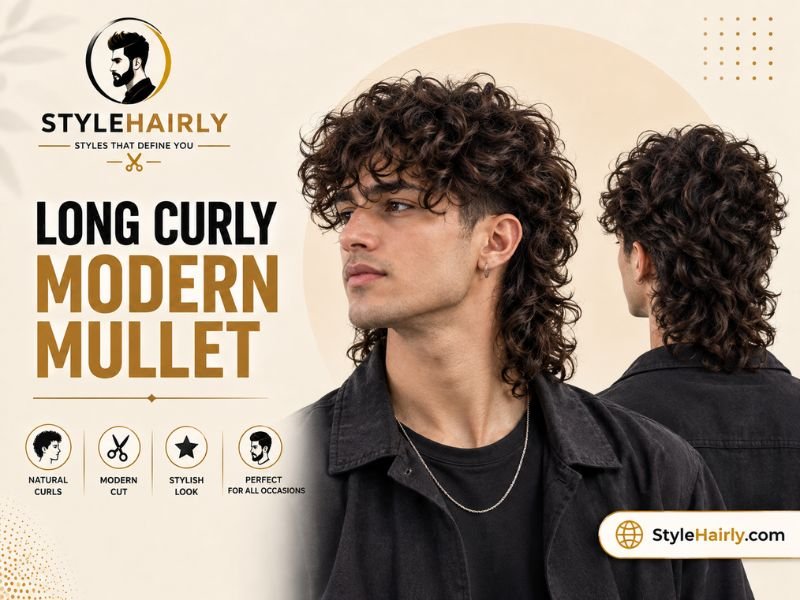
Curly hair changes how this haircut behaves because the curls add natural volume and shrinkage, which affects how long the back actually looks once it dries versus how long it measures when stretched. This version usually needs less structural layering at the crown, since curls already create height and separation on their own.
Best for: people with natural curls or coils who want the mullet shape without straightening their hair to achieve it.
Styling tip: style on damp hair using a curl-defining cream, then avoid touching the hair while it dries to prevent frizz from disrupting the curl pattern at the back.
Maintenance: curly hair should be cut dry or after it has fully air-dried whenever possible, since curls sit differently dry than wet, and this helps the stylist judge the true shape and length of the back section.
Long Straight Hair Modern Mullet
Straight hair shows every layering line clearly, which means this version relies heavily on precise cutting to create the illusion of movement that curly or wavy hair gets naturally. Without enough layering, straight hair can make the back section look like one solid block rather than a textured mullet.
Best for: people with naturally straight hair who want visible texture and separation rather than a flat, uniform length.
Styling tip: a texturizing spray applied to dry hair, combined with loose waves from a curling iron on the ends of the back section, adds movement that straight hair would not otherwise have.
Maintenance: because straight hair shows layering lines more clearly, touch-ups to the crown and sides are worth keeping on a consistent 8-week schedule rather than stretching them out.
Long Modern Mullet for Men With Thick Hair
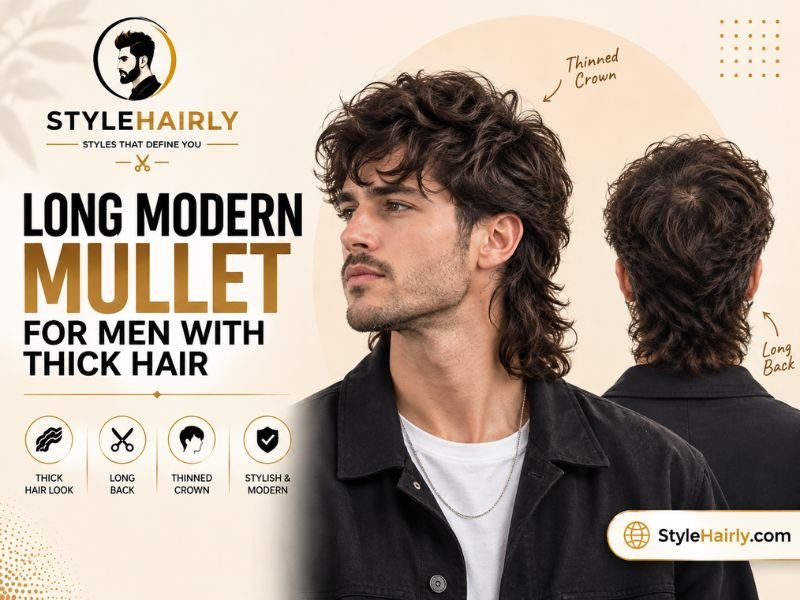
Thick hair holds length and volume well, which makes it well suited to the long back section, but it needs deliberate thinning to avoid looking heavy or triangular at the crown. This version typically uses more aggressive layering and thinning shears than other hair densities require.
Best for: men with dense, thick hair who want to keep the long back without the top and crown looking bulky in comparison.
Styling tip: ask for weight to be removed from the underside of the back section specifically, not just the top layer, since thick hair often hides bulk underneath that is not visible until the hair is styled.
Maintenance: thick hair tends to hold its shape slightly longer than fine hair, but the crown should still be checked every 8 to 10 weeks to prevent it from growing into a heavy, undefined mass.
Long Modern Mullet With Flow
This version emphasizes a swept-back, wave-like movement through the crown and top, often associated with a longer, styled front section that flows into the rest of the layers rather than a choppy, fringe-forward top.
Best for: people who want a more polished, styled appearance rather than a purely textured or shaggy finish.
Styling tip: blow-dry the top section back and slightly up using a round brush, then set it with a light-hold spray so the flow holds through the day without looking stiff.
Maintenance: the front and crown pieces that create the flow need regular trims to keep their length proportional to the rest of the layers, generally every 6 to 8 weeks.
Long Modern Mullet Hair Type Comparison
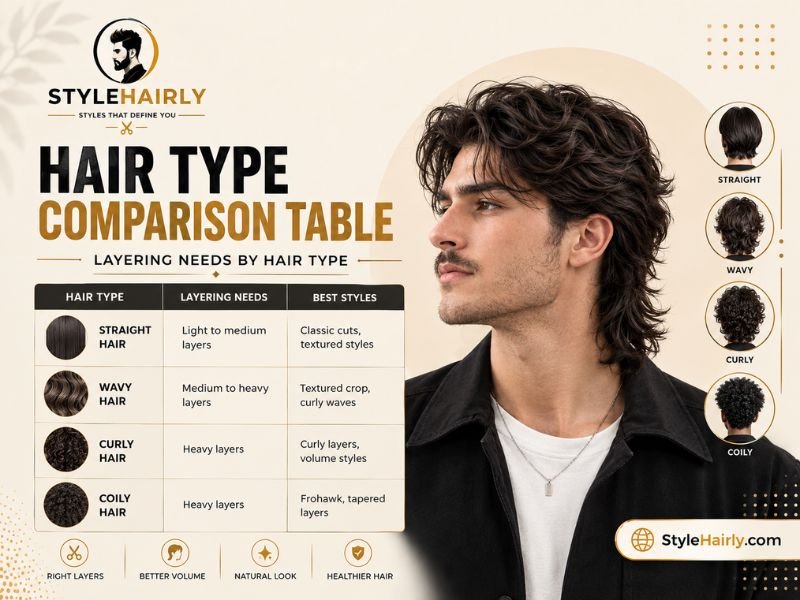
| Hair Type | Layering Needs | Styling Focus |
| Straight | Heavier layering for movement | Texturizing spray, loose waves on ends |
| Wavy | Moderate layering | Minimal effort, natural texture enhancement |
| Curly | Thinning at back, less at crown | Curl-defining cream, dry cutting |
| Thick | Aggressive thinning throughout | Weight removal from underside |
| Fine | Minimal, strategic layering | Volumizing products, avoid over-thinning |
What to Tell Your Hairstylist
Coming in with clear direction makes it easier for a stylist to deliver the specific version of this cut that matches what is expected.
- State the desired back length clearly, such as “shoulder length” or “mid-back,” rather than saying “long.”
- Specify how much layering is wanted at the crown, since this is what separates a long modern mullet from an unshaped long mullet.
- Mention face-framing preferences if softer pieces around the face are wanted.
- Clarify whether a fade or taper is wanted at the sides and neckline, or whether longer sides are preferred instead.
- Say how much volume is wanted at the top, since this affects how much length is removed from the crown.
- Mention anything to avoid, such as not wanting the sides cut too short or not wanting heavy thinning on fine hair.
Results vary based on natural hair density, growth pattern, and how the hair behaves once cut, so it helps to treat these as starting points for a conversation rather than a guaranteed outcome.
Frequently Asked Questions
Is a long modern mullet good for fine hair? Yes, but it needs lighter layering than other hair types. Fine hair can look sparse or stringy at the back if too much weight is removed, so a stylist should focus on strategic, minimal layering rather than heavy thinning.
Does a long modern mullet work on curly hair? Yes. Curly hair often needs less structural layering at the crown since curls naturally create volume and height, though the back section usually benefits from thinning to avoid excess bulk.
What face shape suits a long modern mullet best? Oval faces suit most versions without adjustment. Round and long faces usually need changes to crown height, while square and heart-shaped faces benefit from softer layers near the jaw or forehead.
Is a long modern mullet high maintenance? The top and sides need trims every 8 to 12 weeks to keep the shape defined, though the long back section itself does not need frequent cutting. A fade variation requires more frequent upkeep, closer to every 3 to 4 weeks.
How do I style a long modern mullet at home? Rough-dry with fingers for volume, apply a texturizing product to the top and sides, and add light waves or twists to the back section for separation. A light-hold finishing spray helps the shape last through the day.
What should I ask my hairstylist for? Be specific about the desired back length, how much layering is wanted at the crown, and whether the sides should be faded, tapered, or left longer. Clear, specific direction produces more consistent results than general terms like “mullet.”
How long does a long modern mullet last before needing reshaping? Most versions hold their shape for 8 to 12 weeks before the crown and sides need reshaping. Faded versions lose definition faster and typically need attention every 3 to 4 weeks.
Conclusion
A long modern mullet comes down to the relationship between a long, flowing back and a shorter, well-layered top and sides. The specific variation that works best depends on hair type, how much length has already been grown, and how much contrast is wanted between the short and long sections. Straight hair generally needs more deliberate layering to create movement, curly hair needs careful thinning to control volume, and thick hair usually needs the most aggressive layer removal of all. Whichever version is chosen, the shape depends on regular trims to the crown and sides even while the back is left to grow, since that is what keeps the cut looking like an intentional style rather than hair that has simply been left alone.

1 thought on “Long Modern Mullet: 9 Best Style Ideas That Actually Flatter 2026”